In its May 27th edition, the Economist presents two research papers* on social mobility, which both confirm that European society is far less stable than America's.
The aim of the European welfare states and their redistribution of wealth and income is to rid society of class and move people up the ladder. At the same time Europeans maintain a static view of society. They dislike the extremes of wealth and poverty in America and believe that too much job mobility leads to insecurity. In addition, they are wary of capitalism and market powers. Social stability is thus desirable even if it comes for a price: inflexibility when it comes to market competition and the labour market.
Yet, in reality, European society - and especially in the Nordic countries - is far more mobile than America's. The two research papers define mobility as the difference of income between children and their parents or how long people in one income group stays there. Based on this factor, Nordic countries stand out.
The studies found that it is mobility at the bottom rather than overall social mobility that is most significant. And it is here where the difference between the Nordic countries and America is greatest. In the Nordic countries (as well as in Britain) over 70 % of the poorest childrens escaped from poverty within one generation. In America that figure is around 50 %. Furthermore, in the Nordic countries the link between the earnings of parents and children near the bottom is almost non-existent. However, when it comes social mobility at the middle-class levels the difference between Europe and America is not that big.
So what explains this situation? The first explanation is the tax and welfare systems (redistribution) in the Nordic countries.
One might expect social mobility and economic flexbility to go together - in fact, to be two sides of the same coin. But to the extent that redistribution is an explanation, it implies the opposite: that social mobility is a product of high public spending, a bit like the low incidence of poverty or longer life expectancy (on both of which Europe also does better than America). But greater public spending tends also to be associated with less economic flexibility - which is why Nordic countries have sought to limit the more arthritis-inducing features of their tax-and-spend programmes.
But redistribution is not the whole explanation. Education is the next crucial factor for social mobility, especially an education system that is less class-divided than the American one (or the rest of Europe for that matter). All four Nordic countries fair very well in international comparisons (e.g. OECD) of their education systems.
Eric Sundström provides some political commentary on these research findings and the article in the Economist (in Swedish).
* "Non-linerarities in Inter-generational Earnings Mobility" and "American Exceptionalism in a New Light" (multiple authors)

Tuesday, June 13, 2006


Monday, June 12, 2006
Underground Etiquette
Jonas Morian Promemorian gives tourists or others who don't travel on the Stockholm underground that often some tips on how to behave and what to avoid in order not to annoy fellow passengers. These could be equally applied to underground systems elsewhere (with some moderation).
(Free translation)
Stockholm underground system is starting to fill up by people who apparently are unfamiliar with the city's unwritten rules. Since I like tourism, but hate lack of respect for social codes, I give you - in an eagerly awaited and updated repeat from June 2005 - some tips for you who visit our beautiful capital:
(Free translation)
Stockholm underground system is starting to fill up by people who apparently are unfamiliar with the city's unwritten rules. Since I like tourism, but hate lack of respect for social codes, I give you - in an eagerly awaited and updated repeat from June 2005 - some tips for you who visit our beautiful capital:
- One cannot swipe all sorts of tickets through the automatic barriers and expect them to open. They only work with tickets with a magnetic stripe.
- Find out where you are going before approaching the ticket booth. Admittedly staff are expected to provide tips on nice sites in Stockholm and how you can get there with the underground and other means of public transportation, but striking up a long conversation is not appreciated by those queueing behind you.
- On the escalators people walk to the left. Preferably in a fast pace. You stand to the right - but we prefer that you still move forward albeit in a slower pace than in the left lane.
- When you are at the top of the escalator (or at the bottom for that matter) keep on going in the same direction. If you are unsure where you are going, yield immediately and let the people behind you pass. Don't stop and look around you. Observ that this rule applies equally to lifts and underground trains.
- Respect your co-passengers' personal spheres. In plain terms: don't stand too close. Sure, it can be difficult in rush hour on a full train, but always try to at least avoid body contact.
- It is good to keep a low, relaxed profile. Your fellow passengers are not potential new friends. On the other hand it is of course alright to ask for directions. But don't count on Stockholmers to understand what you mean if you ask for track or line numbers.
- On the underground maps the different lines are marked in blue, green and red. This has nowadays no direct correlation with the colour of the actual underground car. You don't need to sit and wait for a red train to be certain that the train really to Ropsten really takes you to Ropsten.
- Occupy one seat on the underground. Your bag does not need its own seat. If you choose to stand instead of sitting, take off your backpack. Okay, many Stockholmers don't always follow this rule but I promise that we appreciate you more if you do.
- Let people get off the train before you try to get on. See also the comment to rule 8.
Finally Promemorian points us to this site on underground etiquette in London for further inspiration.
Sunday, June 04, 2006
From Honour Killings to Suicides
As part of its bid to meet EU membership requirements, Turkey in 2005 approved new legislation making "honour killings" - the practice of men killing their female relatives for perceived immoral behaviour - punishable by life in prison. So far so good. However, growing numbers of female suicides raise suspicion that women are now being forced or pressured by relatives to kill themselves instead. An estimated 70 women die in honour killings in Turkey every year, mostly in the south-east, the country's poorest and most conservative region, and now suicides seem to reach similar numbers. The real figure may be higher as in remote villages, deaths (or births) are not always recorded. In a survey conducted in this region in 2005, 40 % of males said a women guilty of adultery should be killed. And violence against women is accepted across Turkey. Domestic violence is considered a family matter.
Hopefully the prospect of future EU membership will create enough political willpower to enforce further legislation and lasting positive change.
(Earlier post about Turkey)
Hopefully the prospect of future EU membership will create enough political willpower to enforce further legislation and lasting positive change.
(Earlier post about Turkey)
Saturday, June 03, 2006
The Status Syndrome
I went to a very interesting book launch and seminar on 30 May. Sir Michael Marmot presented his book The Status Syndrome - How our social position affects our health and life expectancy.
Genes, lifestyle and access to healthcare are important for health, but other factors matter even more; how we live in society and what our situation at work is like. Michael Marmot has examined the relation between status and health - the status syndrome - and highlights the importance of e.g. education, income, parents' background and occupation. Based on three decades of research he presents evidence for how subtle differences in social position can lead to important differences in health and life expectancy.
The Status Syndrome is not about illness for the poor and good health for everybody else, but about a continuous variation, a so-called health gradient. Already in the 1970s Marmot studied British civil servants and found that illness frequency and mortality increased the further down the social ladder he looked. The same pattern is found all around the world, including in Sweden. (Marmot also studied baboons and found a similar pattern of mortality depending on dominance or subordinance.) In Washington D.C. the average life expectancy between a black person in the inner city is over 20 years shorter than a rich white person 15 metro stops away in Maryland. In the industrialised countries we think that we have solved everything, but we have huge inequalities in health. The so-called Swedish paradox is that Sweden has the widest inequalities in health in Europe (except in absolute terms), e.g. the mortality of manual v. non-manual labour.
Over a certain level of resources it is what people have in comparison to others that is decisive for their health. Money by itself does not matter - it is what you can do with the money relative to other people that matters. According to Marmot's research people prefer relative standing rather than more money in absolute terms. One anecdote from Marmot's studies is that Oscar winners on average live four years longer than colleagues who have been "just" nominated. Another example is that mortality is higher among people with a Masters than among people with a Doctorate.
Supporting relations in the private sphere and the degree of trust and social solidarity in the society are central dimensions for health. Control, social participation and health are fundamental needs that are linked. As people are different, inequalities will always exist, but the scope of their effects on health can be controlled according to Marmot. If we understand the link between inequalities and health, we can do something about it.
** Sir Michael Marmot is Professor in Epidemiology and Public Health at UCL and Head of the International Centre for Health and Society. He is also Chairman of the WHO's Global Commission on Social Determinants of Health. In 2004 he was awarded the Balzan Prize in epidemiology and in 2000 he was knighted for his efforts within epidemiology and the understanding of inequalities in health.
Genes, lifestyle and access to healthcare are important for health, but other factors matter even more; how we live in society and what our situation at work is like. Michael Marmot has examined the relation between status and health - the status syndrome - and highlights the importance of e.g. education, income, parents' background and occupation. Based on three decades of research he presents evidence for how subtle differences in social position can lead to important differences in health and life expectancy.
The Status Syndrome is not about illness for the poor and good health for everybody else, but about a continuous variation, a so-called health gradient. Already in the 1970s Marmot studied British civil servants and found that illness frequency and mortality increased the further down the social ladder he looked. The same pattern is found all around the world, including in Sweden. (Marmot also studied baboons and found a similar pattern of mortality depending on dominance or subordinance.) In Washington D.C. the average life expectancy between a black person in the inner city is over 20 years shorter than a rich white person 15 metro stops away in Maryland. In the industrialised countries we think that we have solved everything, but we have huge inequalities in health. The so-called Swedish paradox is that Sweden has the widest inequalities in health in Europe (except in absolute terms), e.g. the mortality of manual v. non-manual labour.
Over a certain level of resources it is what people have in comparison to others that is decisive for their health. Money by itself does not matter - it is what you can do with the money relative to other people that matters. According to Marmot's research people prefer relative standing rather than more money in absolute terms. One anecdote from Marmot's studies is that Oscar winners on average live four years longer than colleagues who have been "just" nominated. Another example is that mortality is higher among people with a Masters than among people with a Doctorate.
Supporting relations in the private sphere and the degree of trust and social solidarity in the society are central dimensions for health. Control, social participation and health are fundamental needs that are linked. As people are different, inequalities will always exist, but the scope of their effects on health can be controlled according to Marmot. If we understand the link between inequalities and health, we can do something about it.
** Sir Michael Marmot is Professor in Epidemiology and Public Health at UCL and Head of the International Centre for Health and Society. He is also Chairman of the WHO's Global Commission on Social Determinants of Health. In 2004 he was awarded the Balzan Prize in epidemiology and in 2000 he was knighted for his efforts within epidemiology and the understanding of inequalities in health.
Thursday, June 01, 2006
Congestion Charge Update 2
It would actually be quite nice if the American ambassador in Britain could pay the charge...and not actually try and skive out of it like a chiselling little crook.
Ken Livingstone, London's Mayor, on the US embassy's refusal to pay the toll levied on cars driven in central London. Some foreign 50 embassies say they are exempt under the international diplomatic law.
In Stockholm this is not an issue since the congestion is theoretically and legally a tax, which diplomatic services are automatically exempted from. Considering the small sums involved in the scheme of things, it is very disappointing that the US embassy in London doesn't just pay.
Since my last update, a poll has shown that Stockholmers are very much in favour of the trial and that the reduction of traffic seems to be constant.
For April:
Ken Livingstone, London's Mayor, on the US embassy's refusal to pay the toll levied on cars driven in central London. Some foreign 50 embassies say they are exempt under the international diplomatic law.
In Stockholm this is not an issue since the congestion is theoretically and legally a tax, which diplomatic services are automatically exempted from. Considering the small sums involved in the scheme of things, it is very disappointing that the US embassy in London doesn't just pay.
Since my last update, a poll has shown that Stockholmers are very much in favour of the trial and that the reduction of traffic seems to be constant.
For April:
- Car traffic in central Stockholm was 22 % lower than the same period in 2005
- Traffic on Essingeleden (bypass) has increased 4-5 % compared to 2005
- The number of public transport passengers to and from the inner city increased with 65,000 which is equivalent to 30,000 more passengers per day compared to April 2005
The recent Sifo poll showed that 6 out of 10 people are in favour of permanent congestion charges although to a even more recent survey published today 60 % are against the charge. So who knows! Will be interesting to see May's traffic results and further polls on the issue.
Tuesday, May 30, 2006
The Future of the EU
Yesterday I attended a very interesting seminar with Professor Sverker Gustavsson, Swedish political scientist, and Annika Ström-Melin, head of the Swedish Institute for European Policy Studies. Each approached the topic of the future of the EU and especially the future of the constitution from quite different angles:
Sverker Gustavsson
- The EU does not have to create clarity by writing down or bringing together the existing treaties into one. That would do more harm than good to the EU. Clarity is not always a good thing.
- Compare the Swedish constitution. The Swedish constitution does not provide clarity on matters that are regulated outside politics, albeit matters covered by the principle/freedom of assembly (e.g. the labour market and unions). This makes it a "living constitution". In reality nothing important is clear from the Swedish constitution except how to elect and appoint a government.
- There are two forces: the right to vote v. capitalism (or the right of ownership). It is the use of the rights in the constitution that decide politics, and that is very far from any sort of clarity.
- There is a similar "terror balance" between free trade and the right to vote / freedom of assembly in the EU. One result from this struggle is that free trade and the four freedoms are not applied to the same extent on services or on goods and services paid by taxes. This is an issue that could potentially be contested in the ECJ but since all or most of the EU member states have similar systems, the EU does not want to take on that conflict and disturb the balance. There is a a "mutual insight that either 'side' could destroy each other if the principle [of free trade] was applied fully".
- Instead of writing down the EU should decide where the breaking point between the two poles (rights) ought to be. In other words the EU should engage in a debate about basic values and concentrate on how to create more flexibility and reform. That is the real constitutional debate.
- In addition, the EU and its member states should iron out the formal aspects of the constitution and concentrate on the content of politics. Formality is not that important. It does not hinder further enlargement of the EU. If the EU wants to bring in new members, it will do so irrespective of any imagined formal restrictions. What is important is that the lawyers dare to do.
Annika Ström-Melin
- The period of reflection that the EU has announced is worrying because the conflicts in Europe are still just under the surface. And the European countries have not even started dealing with the years of communist oppression. In other words, one cannot be sure that Europe will continue to be peaceful.
- Europe should not underestimate the potential destructive force of nationalism. European integration has grown out of the fact that nationalism led to horrific events and circumstances. European leaders "tricked" countries to co-operate. Compare with the Council of Europe which is mostly about proclamations and solemnity.
- The EU is very good and effective - but lack of clarity is a huge problem. And it is linked to the question of democracy. In Sweden we have regulated basic freedoms and rights but in the EU democracy is only indirect. The member states have delegated more than free trade, areas coming very near to the inner core of the right to vote.
- The constitutional treaty was good because it summed up what European co-operation looks like today. Civil freedoms and rights must be engrained in a constitution in order to place limits on the expansion of the EU's power. For example, Sweden would not want the issue of abortion to be decided by the Polish government. Swedes' right to vote on that issue must remain in Sweden.
- The EU cannot continue as before, according to the usual method. The EU we have today functions pretty well; neither more nor less is needed. However, Europe needs clarity on what is it we have today.
- The democratic deficit is the price we pay for keeping conflicts out. Europe for peace is not an obsolete idea.
- The EU is the best available method. European co-operation is a method for our time. Decisions must in many areas be taken on another level than by the nation-state. But we will never have full franchise at the European level.
Sunday, May 28, 2006
Sigh...
"I think, like, it is already dead, what's the harm."
Victoria Silvstedt, about her chinchilla fur coat. Swedish model who fulfils the stereotype of a stupid blonde.
Victoria Silvstedt, about her chinchilla fur coat. Swedish model who fulfils the stereotype of a stupid blonde.
Friday, May 26, 2006
Thursday, May 25, 2006
For a very special person
Blue eyes
Happy frame of mind
Oh, so blue
In times of despair
Shades of grey
Glimpse of your soul
If only eyes could tell
Happy frame of mind
Oh, so blue
In times of despair
Shades of grey
Glimpse of your soul
If only eyes could tell
Gangsta' Style
A few weeks I went to a 30th birthday party with a 1930s/gangster theme. Here are some pics for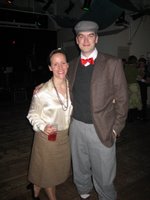 you to enjoy!

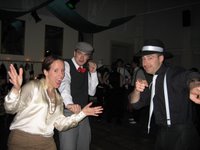
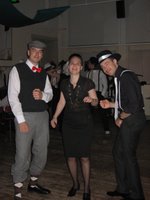
 you to enjoy!

Tuesday, May 16, 2006
Eavesdropping
There's a great new Swedish site with things people have overheard on the tube, at work/school or when out and about, Tjuvlyssnat (inspired by Overheard in New York). Unfortunately it's only in Swedish but I'll treat you to a sample:
On the Stockholm tube
High school girl #1: I can't wait to the summer holidays, I'm going to Greece again
High school girl #2: Oohh, nice, I would also like to do that, I have never been there. By the way, Greece is not in Europe, is it?!
High school girl 1 #1: Yes, it is.
High school girl #2: No, I'm quite sure it isn't.
High school girl #1: (irritated): Yes, I know it is, they had euros there.. and you haven't been there. So I know I'm right!
High school girl #2: Okay, but it wasn't in Europe before they joined the EU at least.
High school girl #1: No, that's probably true. But no country was.
On the Stockholm tube
High school girl #1: I can't wait to the summer holidays, I'm going to Greece again
High school girl #2: Oohh, nice, I would also like to do that, I have never been there. By the way, Greece is not in Europe, is it?!
High school girl 1 #1: Yes, it is.
High school girl #2: No, I'm quite sure it isn't.
High school girl #1: (irritated): Yes, I know it is, they had euros there.. and you haven't been there. So I know I'm right!
High school girl #2: Okay, but it wasn't in Europe before they joined the EU at least.
High school girl #1: No, that's probably true. But no country was.
Monday, May 15, 2006
Tom Tits Experiments
Despite a name that may lead your thoughts to something else, Tom Tits Experiment is actually Sweden's largest science park and it is located in my hometown Södertälje. Over the weekend Tom Tits won the Micheletti prize at the European Museum Forum, awarded to the most promising technical or industrial museum. The jury stated Tom Tits as one of Europe's most interesting museums and highlighted the museum's ambition to attempt to explain basic scientific principles to a broad general public.
(The Museum of the Year Award went to Cosmocaixa in Barcelona and Churchill Museum in London received the Council of Europe Award.)
(The Museum of the Year Award went to Cosmocaixa in Barcelona and Churchill Museum in London received the Council of Europe Award.)
Thursday, May 04, 2006
Iraq? Nah, never heard of it
National Geographic reports that young Americans do not where Iraq is. Despite the US having invaded the country twice and having fought a war there for the past three years, a war that features in the news basically every day, two of three or 63 % youths between 18 and 24 could not point out Iraq on a map. Even fewer knew where Israel or Iran are situated. Moreover, and maybe this is the most scary result, only 50 % could locate New York...
And these are the people that will run that country in the future...
And these are the people that will run that country in the future...
Easter Bunnies

It's long overdue but here's the picture of Marianne (right) and me when we met up at in Brussels at Easter, which I promised her I would post.
Thursday, April 20, 2006
The Society for Threats to Western (American) Thinking
Posted in the St Antony's college (Oxford) JCR (Junior Common Room) newsletter:
Society for Threats to Western (American) Thinking – Monday April 24
The Society for Threats to Western (American) Thinking is proud to announce a special screening of “The Rock” (1996). Monday 24 April 20:00 in the CCR.
Dear friends,
As Trinity Term opens for business and we all get down to the serious regime of examinations, theses, jobs, or procrastination it is - above all - a time for reflection. We have come a long way since SARS and, in the spirit of reflection, it is time we redefine the paradigm surrounding terrorism. Once upon a time we actually UNDERSTOOD this debate, however, as global events conspired against us, academics had to ruin it for everyone with lecture series, books, articles, journals and laborious debates. Through the infinite glory of Hollywood we will engage and defeat this tangental thinking.
The Rock delves into the disgruntled mind of the military machine, threats from deadly biological agents, and a man's search for justice in the face of statist domination. Set in San Fransico and Alcatraz the subtle comparison between liberal freedom and state oppression.
Starring: Connery S., Cage N. and Harris E.
Director: Bay M.
Producer: Bruckheimer J.I
t is time to reclaim the knowledge we have lost. Join us. Threats to Western (American) Thinking is a strategic think-tank, operating from Oxford, dedicated to simplifying debates into soundbite analysis. We aim to destroy subtle discussions with crass generalisations, simplisticanalysis, and overblown PR.
Society for Threats to Western (American) Thinking – Monday April 24
The Society for Threats to Western (American) Thinking is proud to announce a special screening of “The Rock” (1996). Monday 24 April 20:00 in the CCR.
Dear friends,
As Trinity Term opens for business and we all get down to the serious regime of examinations, theses, jobs, or procrastination it is - above all - a time for reflection. We have come a long way since SARS and, in the spirit of reflection, it is time we redefine the paradigm surrounding terrorism. Once upon a time we actually UNDERSTOOD this debate, however, as global events conspired against us, academics had to ruin it for everyone with lecture series, books, articles, journals and laborious debates. Through the infinite glory of Hollywood we will engage and defeat this tangental thinking.
The Rock delves into the disgruntled mind of the military machine, threats from deadly biological agents, and a man's search for justice in the face of statist domination. Set in San Fransico and Alcatraz the subtle comparison between liberal freedom and state oppression.
Starring: Connery S., Cage N. and Harris E.
Director: Bay M.
Producer: Bruckheimer J.I
t is time to reclaim the knowledge we have lost. Join us. Threats to Western (American) Thinking is a strategic think-tank, operating from Oxford, dedicated to simplifying debates into soundbite analysis. We aim to destroy subtle discussions with crass generalisations, simplisticanalysis, and overblown PR.
Monday, April 10, 2006
Royal Stats
In honour of Queen Elizabeth's 80th birthday on 21 April (though officially celebrated in June), the Royal Court has published 80 more or less essential facts about the British Head of State. A selection of her "accomplishments":
- Has modelled for 139 official portraits (even a hologram one)
- Inaugurated 25 ships and 15 bridges
- Sent her first e-mail from an army base in 1976
- Treated her staff to 78,000 Christmas puddings
- Has sent 280,000 telegrams to couples celebrating diamond their anniversary
- Travelled on the London tube for the first time in 1939 (perhaps the only time?)
Perhaps telling of her age and her early succession to the throne; there have been ten British PMs and ten American presidents as well as six Archbishops of Canterbury during her reign.
Monday, April 03, 2006
Kid Fun
You can learn a lot from spending the day with a six-year-old:
- Kids get pretty cranky when they haven't eaten for a while (don't let the kid at the table next to yours stare too much at your kid before he or she has a stabilised blood sugar level)
- Kids talk (and laugh) all through the film while at the cinema (at least when seeing Ice Age 2)
- Kids can eat a huge box of popcorn and drink a supersize soda just after having had lunch (okay, I helped but still)
- Not all kids like spaghetti and meat sauce - at least one Swedish girl wanted black pudding (or pancakes - more normal) for dinner on a Saturday
- McDonald's face paint itches a lot and needs to come off five minutes from home, not a minute later
- Six-year-olds can be surprisingly good at sudoku
- Three bedtime stories and two sudokus later the kid is still not tired ("I'm not tired at all") - as soon as she's allowed to sleep on the sofa in the living room, she's out in three seconds
- It's good to have a few household chores to do as an excuse to get out of playing a fifth boardgame in an hour
- Six-year-olds are already familiar with the local slang
Wednesday, March 22, 2006
On the Rocks
"You have to be pretty drunk to want to sleep here."
Ryszard Kapuściński, literary journalist visiting the Ice Hotel in Jukkasjärvi in the very north of Sweden. He felt the hotel's beds were a bit too chilly for his taste.
Ryszard Kapuściński, literary journalist visiting the Ice Hotel in Jukkasjärvi in the very north of Sweden. He felt the hotel's beds were a bit too chilly for his taste.
Sunday, March 19, 2006
Vanity
Would you do it?
Top Five Female Ops
Top Five Female Ops
- Breast surgery. Resizing or reshaping under full anesthetic; 1 or 2 nights in hospital, stitches out in 7-14 days
- Rhinoplasty. Nose reshaping, needs an overnight stay and 7-10 days for the swelling to subside
- Liposuction. Fat removal under local anesthetic takes 1-2 hours; anoterh week or two for the area to heal
- Blepharoplasty. Excess tissue around the eye is surgically removed; stitches removed in 3-7 days
- Abdominoplasty. Surgery to remove excess skin and fat from the belly; needs 2 weeks off work and lots of bed rest
Top Five Male Ops
- Rhinoplasty. Nose reshaping is the most popular op
- Liposuction. To reduce breast size or get a flatter belly
- Blepharoplasty. Men also dislike saggy, baggy eyes and laugh lines
- Otoplasty. Ear reshaping by removing skin and cartilage and restitching into place. In bandages for a week
- Penis enlargement. A small incision at the base can extend flaccid size by about 2,5 cm; body-fat cells can be implanted to increase girth. Expect a week off work and no heavy lifting for a month
* Source: Harley Medical Group / Time
Thursday, March 16, 2006
The right to own a pet
You might have seen this being reported the other week...
Americans know more about Simpsons than about their basic rights and freedoms
McCormick Tribune Freedom Museum in Chicago is a new museum aimed at informing the American public about the Constitution. The museum did a survey of Americans' knowledge of their basic rights and freedoms and found that:
Americans know more about Simpsons than about their basic rights and freedoms
McCormick Tribune Freedom Museum in Chicago is a new museum aimed at informing the American public about the Constitution. The museum did a survey of Americans' knowledge of their basic rights and freedoms and found that:
- 28 % were able to list two out of five basic freedoms in the First Amendment
- 69 % knew that freedom of speech is one of the five freedoms
- 24 % knew about freedom of religion
- 11 % were aware of freedom of the press
- 10 % were familiar with the freedom of assembly
- only 1 % knew about their right to appeal
This can be compared with the fact that 52 % could name at least two members of the Simpson family.
Another finding of the survey is that many Americans think they have constitutional rights that are not found in the Constitution:
- 1/5 thought the right to own a pet was part of the First Amendment
- As many believed the right to drive a car was in the same amendment (even though the car was invented a century after the establishment of the Constitution
Thursday, March 09, 2006
If only it was that easy!
Italian PM Berlusconi has advised his country's poor to make more money. Italy's richest man apparently started his business by picking up paper off the streets and crumpled them to little balls that he sold to people who used them to light their stoves. And when someone gave the young Berlusconi a camera he started taking pictures at funerals and weddings.
All good ideas...hm...unsurprisingly Berlusconi's popularity is falling as a result of his government's difficulties to get the Italian economy going. The latest opinion polls show that Berlusconi's centre-right alliance will lose to former Commission President Prodi's centre-left bloc - I hope so!
All good ideas...hm...unsurprisingly Berlusconi's popularity is falling as a result of his government's difficulties to get the Italian economy going. The latest opinion polls show that Berlusconi's centre-right alliance will lose to former Commission President Prodi's centre-left bloc - I hope so!
Monday, March 06, 2006
Petition against Trafficking during the Football World Cup
With International Women's Day coming up on Wednesday I want to highlight a very important fight.
A petition against trafficking during the Football World Cup in Germany in June.
As prostitution is legal in Germany and plans are under way to set up mobile brothels, it is very likely that trafficking of women and forced prostitution will significantly increase during the event.
Let's help protect women from such exploitation.
A petition against trafficking during the Football World Cup in Germany in June.
As prostitution is legal in Germany and plans are under way to set up mobile brothels, it is very likely that trafficking of women and forced prostitution will significantly increase during the event.
Let's help protect women from such exploitation.
Friday, March 03, 2006
Olof Palme
I wanted to blog about Olof Palme already on February 28 (the anniversary of his murder) but haven't gotten around to it until today. But instead of writing about him myself I will link to tributes from my fellow bloggers:
Olof Palme...and Bruce Springsteen
En märklig känsla av vemod (Swedish)
And a news article.
For those of you who need an introduction, here's his life (and death).
I was 10 when Palme was murdered. Having grown up in a Social Democratic home I was already very familiar with who he was and with his politics. And it's obviously not every day a country's Prime Minister is murdered (though sadly it happened in Sweden yet again in 2003 when Foreign Minister Anna Lindh was knifed down; fortunately that case has been solved) so it's one of those things you remember forever. I had spent the night at my grandparents' and turned on the radio in the morning to listen to a radio play. We couldn't understand how the writers could joke about such a thing, before it started to sink in that it had actually happened. I remember that my grandmother cried but I don't think I did. I also remember that they cancelled all TV shows and just played sad music on TV all day. I will also always associate Palme's murder with getting my ears pierced. I hadn't had it done that very day but two days earlier and I guess my ears were still hurting. Weird how one's memory works.
Olof Palme...and Bruce Springsteen
En märklig känsla av vemod (Swedish)
And a news article.
For those of you who need an introduction, here's his life (and death).
I was 10 when Palme was murdered. Having grown up in a Social Democratic home I was already very familiar with who he was and with his politics. And it's obviously not every day a country's Prime Minister is murdered (though sadly it happened in Sweden yet again in 2003 when Foreign Minister Anna Lindh was knifed down; fortunately that case has been solved) so it's one of those things you remember forever. I had spent the night at my grandparents' and turned on the radio in the morning to listen to a radio play. We couldn't understand how the writers could joke about such a thing, before it started to sink in that it had actually happened. I remember that my grandmother cried but I don't think I did. I also remember that they cancelled all TV shows and just played sad music on TV all day. I will also always associate Palme's murder with getting my ears pierced. I hadn't had it done that very day but two days earlier and I guess my ears were still hurting. Weird how one's memory works.
Monday, February 27, 2006
Olympic Success
Sweden had its best Winter Olympics ever in Turin! We finished 6 in the "medal league", after:
1. Germany 11-12-6=29
2. USA 9-9-7=25
3. Austria 9-7-7=23
4. Russia 8-6-8=22
5. Canada 7-10-7=24
6. SWEDEN 7-2-5=14
7... R.o.W
Most Swedes would say that winning the Gold in ice-hockey was the best, but I'm the most excited - and proud - about the women's curling team who actually have to work for a living (e.g. one team member is a consultant, another an accountant) and train in their spare time. A reality quite far from the luxury life of the ice-hockey players who are almost all professionals playing in the NHL. The curling team even had to finance part of the trip themselves. Of course, the ice-hockey players have worked hard to get where they are today, but it doesn't make them bigger stars or their gold worth more than the curling ladies' golden medal.
1. Germany 11-12-6=29
2. USA 9-9-7=25
3. Austria 9-7-7=23
4. Russia 8-6-8=22
5. Canada 7-10-7=24
6. SWEDEN 7-2-5=14
7... R.o.W
Most Swedes would say that winning the Gold in ice-hockey was the best, but I'm the most excited - and proud - about the women's curling team who actually have to work for a living (e.g. one team member is a consultant, another an accountant) and train in their spare time. A reality quite far from the luxury life of the ice-hockey players who are almost all professionals playing in the NHL. The curling team even had to finance part of the trip themselves. Of course, the ice-hockey players have worked hard to get where they are today, but it doesn't make them bigger stars or their gold worth more than the curling ladies' golden medal.
Wednesday, February 22, 2006
Congestion Charges Update
I wrote earlier about the congestion charges introduced in the centre of Stockholm at the beginning of the year. I am very pleaset to tell you that so far they have been a huge success! Such a success that the political debate has if not died out but almost disappeared. The parties that were against charges (or "tax" as they call it) are still against (though they were the ones that had launched the idea in the first place, as I mentioned in my previous posting), but they are not as vocal about it in the fear of (I think) alienating voters.
The results so far:
But so far so good! I really hope the continuous success of the trial period leads to Stockholmers voting for a permanent (or as long as congestion and the environment so require) introduction of congestion charges!
The results so far:
- Substantial decrease in congestion on the streets of Stockholm - halving of travel times in rush hour and buses having to hold for a minute at bus stops not to get ahead of their timetable
- 25 % decrease in traffic on weekdays
- No significant increase in traffic on ringroads (e.g. Essingeleden)
- 40,000 more people commuting by public transportation, without any major problems for SL
- Well-functioning technical and administrative system and not total chaos as critics feared
But so far so good! I really hope the continuous success of the trial period leads to Stockholmers voting for a permanent (or as long as congestion and the environment so require) introduction of congestion charges!
Monday, February 20, 2006
Good Point
This New York Times article about the film Brokeback Mountain makes an excellent point regarding the belief of many right-wing Christians in the U.S. that homosexuality is essentially a disease or a phase that one can recover from.
"If anyone believes that gay men can actually become ex-gay men, I have just one question for you: Would you want your daughter to marry one?"
"If anyone believes that gay men can actually become ex-gay men, I have just one question for you: Would you want your daughter to marry one?"
Friday, February 17, 2006
One Step Back for the Japanese Monarchy
Earlier this week Japan announced that they are scrapping the plans to change the rules of succession. Without a male heir to the throne - the Crown Prince has only one child, Princess Aiko, and his brother, Prince Akishino, has two daughters (Princess Sayako married a "commoner" and is out) - the Japanese monarchy will end with the present Crown Prince unless Japan allows women to succeed the throne. Reform was under way until it was announced last week that Prince Akishino and his wife are expecting again. The sex of the baby is not known yet but everyone is hoping for a boy.
Suits them right if it's another girl!
Conservatives in Japan also argue that since women are closely associated with blood through menstruation and childbirth, woman cannot ascend the throne since blood is strictly forbidden in sacred places.
Sounds like something Aristotle (or was it Plato?) would have said, who believed that a woman's emotional life and her lack of control over her feelings made her blood boil, forcing her to let it out once a month...
Suits them right if it's another girl!
Conservatives in Japan also argue that since women are closely associated with blood through menstruation and childbirth, woman cannot ascend the throne since blood is strictly forbidden in sacred places.
Sounds like something Aristotle (or was it Plato?) would have said, who believed that a woman's emotional life and her lack of control over her feelings made her blood boil, forcing her to let it out once a month...
Thursday, February 16, 2006
Islam on the Outskirts of the Welfare State
...is an excellent and very interesting article about Muslims in Sweden in the New York Times, written by Christopher Caldwell. It's long but really worth while reading.
Tuesday, February 14, 2006
Poem for my Valentine
En varm kittlande känsla
Jag glömmer allt
Tänker inte
Svävar
Dina ögon ler, skrattar
De tycker om mig
Jag blundar
Flyter
Ett leende, en hand
Jag faller handlöst
Tycker om dig
Lyfter
Jag glömmer allt
Tänker inte
Svävar
Dina ögon ler, skrattar
De tycker om mig
Jag blundar
Flyter
Ett leende, en hand
Jag faller handlöst
Tycker om dig
Lyfter
Monday, February 13, 2006
Habits and Oddities
I've been tagged by Natalie. The task this time is to make a list of five weird habits or pecularities and then challenge five other bloggers to do the same and continue the chain. I have to include these short rules (and here they are) and list who I challenge at the bottom of the post. I also need to inform them on their blogs that they've been tagged!
Okay, here goes:
1. (Dis)organised?
I've always felt that I'm very organised and orderly, and in a way I am. I have a very good memory and I remember a lot of facts and details. Most people see me as very organised, especially at work, but at home I have lots of piles of papers and post laying around. My flat is always clean but it can be a bit messy and I don't really mind. At the same time I like to keep the books on my bookshelf in alphabetic order, like the blogs on the right, so while I'm a bit messy I'm also a control freak if that's possible.
2. Saver-spender
Like Natalie I would say that I'm a saver if I had to choose between saving and spendthrift. But really, I spend most of my salary every month. I can't help myself! Sure, I'm not extravagant; on the contrary, I rather go to H&M than Gucci, but I do spend a lot on clothes, books, trips, etc. Actually, I probably don't go to Gucci because that would entail having to save for a while in order to spend. However, lately I've been pretty good, joining a private pension saving scheme and buying stuff for the flat that were needed.
3. Don't ask me about proverbs!
I have a habit of using slang and I don't like it. Swedish words I use too often are "ba" and "liksom" and in English I say "like" a lot although I'm getting better. One of my colleagues at my new job is so well-articulated and I really wish I were like her. I hardly curse at all so that's good. My mum always told me that swearing is a sign of bad vocabulary and that really stuck to me.
4. TV freak
I follow too many TV series. No, not docu soaps because I absolutely loathe them! I'm talking about Lost, West Wing, Desperate Housewives, O.C., Six Feet Under, CIC... and then there are all the sitcoms and Swedish shows... Good thing I'm pretty good at multi-tasking and can zip channels when three shows are on at the same time at three different stations.
5. So perfect
My last bad habit must be that I think I'm so perfect that I cannot think of a fifth one! ;)
Okay, I challenge Marianne, Nonna, Marina (will all five have to do with a certain perfume addiction?), Nina and Ester!
Okay, here goes:
1. (Dis)organised?
I've always felt that I'm very organised and orderly, and in a way I am. I have a very good memory and I remember a lot of facts and details. Most people see me as very organised, especially at work, but at home I have lots of piles of papers and post laying around. My flat is always clean but it can be a bit messy and I don't really mind. At the same time I like to keep the books on my bookshelf in alphabetic order, like the blogs on the right, so while I'm a bit messy I'm also a control freak if that's possible.
2. Saver-spender
Like Natalie I would say that I'm a saver if I had to choose between saving and spendthrift. But really, I spend most of my salary every month. I can't help myself! Sure, I'm not extravagant; on the contrary, I rather go to H&M than Gucci, but I do spend a lot on clothes, books, trips, etc. Actually, I probably don't go to Gucci because that would entail having to save for a while in order to spend. However, lately I've been pretty good, joining a private pension saving scheme and buying stuff for the flat that were needed.
3. Don't ask me about proverbs!
I have a habit of using slang and I don't like it. Swedish words I use too often are "ba" and "liksom" and in English I say "like" a lot although I'm getting better. One of my colleagues at my new job is so well-articulated and I really wish I were like her. I hardly curse at all so that's good. My mum always told me that swearing is a sign of bad vocabulary and that really stuck to me.
4. TV freak
I follow too many TV series. No, not docu soaps because I absolutely loathe them! I'm talking about Lost, West Wing, Desperate Housewives, O.C., Six Feet Under, CIC... and then there are all the sitcoms and Swedish shows... Good thing I'm pretty good at multi-tasking and can zip channels when three shows are on at the same time at three different stations.
5. So perfect
My last bad habit must be that I think I'm so perfect that I cannot think of a fifth one! ;)
Okay, I challenge Marianne, Nonna, Marina (will all five have to do with a certain perfume addiction?), Nina and Ester!
Wednesday, February 08, 2006
Social Democratic Sweden (and Eric Sundström)
A fellow Social Democrat who I have linked to in my blogs list, Eric Sundström, is excellent at highlighting why most Swedes continue to vote for the Social Democrats (sure, the opposition is leading - or tied - in the polls at the moment but there are still seven months to the election). See his latest post about Sweden's new goal to become the world's first oil-free economy (by 2020).
See also an example of Eric's excellent writing, about the Vaxholm (Laval) conflict) relating to the EU's Service Directive.
See also an example of Eric's excellent writing, about the Vaxholm (Laval) conflict) relating to the EU's Service Directive.
Saturday, February 04, 2006
Having difficulties choosing which book to read next?
Don't worry, there's help! www.whichbook.net lets you put in a few values for what you want from a book and then generates a list for you. Don't forget to move the yellow arrows towards the degree of [value] that you prefer!
Selecting funny, unpredictable, larger than life and unusual generated, among other books:
John Dory
By John Murray
An offbeat tale with some hilarious accounts of the narrator's schooldays; his ongoing war with his teacher, and his scrapes with his friend, Squinty Bar Radish. Underlying the reminiscences is a spiritual quest for meaning, and we are left to decide how far George Singer's enlightenment, through his encounter with the fish, has led him.
It also allows you to choose characters, plots and settings.
So my fellow book-a-holics out there - make your choice!
Selecting funny, unpredictable, larger than life and unusual generated, among other books:
John Dory
By John Murray
An offbeat tale with some hilarious accounts of the narrator's schooldays; his ongoing war with his teacher, and his scrapes with his friend, Squinty Bar Radish. Underlying the reminiscences is a spiritual quest for meaning, and we are left to decide how far George Singer's enlightenment, through his encounter with the fish, has led him.
It also allows you to choose characters, plots and settings.
So my fellow book-a-holics out there - make your choice!
Monday, January 30, 2006
Interesting stats
67 - Average number of children between the ages of 7 and 15 who visit British casualty wards each weekend with broken bones
55 % - Percentage of average dropped on weekends after the two most recent Harry Potter were released
55 % - Percentage of average dropped on weekends after the two most recent Harry Potter were released
Thursday, January 26, 2006
Know your Stockholm
Random facts about the most beautiful capital in the world:
* Built on 14 islands connected by 52 bridges
* The archipelago has 24,000 islands, rocks and skerries
* 77 nationalities presented
* 70,000 people within the city every year (out of 1 million inhabitants; 2 million with suburbs)
* 20,000 people move to Stockholm every year
* 63 churches
* Has the world's first and only national city park
* The city of Stockholm employs 55,000
* 2,500 restaurants
* Stockholmers and Swedes are the second greatest consumers of coffee
* The underground is the world's longest art exhibition
* The City Hall organ is the largest one in Northern Europe with 10,000 pipes
* 106 hotels and youth hostels
* Only major city where hot-air balloon traffic is allowed over the centre
* The tallest building is Kaknästornet, 155 m
* Has more theatres than any other European city
* No downtown water is polluted, allowing for fishing and swimming
* The city seal, St Erik, from 1376, is the world's oldest
* 70,000 pupils attend school; 25,000 pre-school
* Stockholmers and Swedes buy more tulips than anywhere in the world
* The Globe is the world's largest spherical arena
* Regent Birger Jarl founded Stockholm in 1252
* The oldest buildings are Storkyrkan and Riddarholmskyrkan, both dating back to the 13th century
* 8 daily newspapers are published here
* Has 42 public libraries
* Stockholmers and Swedes are the leading consumers of bananas in the world
What about that?!
* Built on 14 islands connected by 52 bridges
* The archipelago has 24,000 islands, rocks and skerries
* 77 nationalities presented
* 70,000 people within the city every year (out of 1 million inhabitants; 2 million with suburbs)
* 20,000 people move to Stockholm every year
* 63 churches
* Has the world's first and only national city park
* The city of Stockholm employs 55,000
* 2,500 restaurants
* Stockholmers and Swedes are the second greatest consumers of coffee
* The underground is the world's longest art exhibition
* The City Hall organ is the largest one in Northern Europe with 10,000 pipes
* 106 hotels and youth hostels
* Only major city where hot-air balloon traffic is allowed over the centre
* The tallest building is Kaknästornet, 155 m
* Has more theatres than any other European city
* No downtown water is polluted, allowing for fishing and swimming
* The city seal, St Erik, from 1376, is the world's oldest
* 70,000 pupils attend school; 25,000 pre-school
* Stockholmers and Swedes buy more tulips than anywhere in the world
* The Globe is the world's largest spherical arena
* Regent Birger Jarl founded Stockholm in 1252
* The oldest buildings are Storkyrkan and Riddarholmskyrkan, both dating back to the 13th century
* 8 daily newspapers are published here
* Has 42 public libraries
* Stockholmers and Swedes are the leading consumers of bananas in the world
What about that?!
Sunday, January 08, 2006
It's a Dangerous World - for Half of the Population
Despite reports that the world is as peaceful as it's ever been, this is certainly not true for most women around the globe.
When looking at the female half of the global population, a depressing and bleak picture presents itself. According to the Geneva Centre for the Democratic Control of the Armed Forces, the world is still very violent, and not just during times of war. Men still fight (and die in) wars but according to the Centre's new report "Women in an Insecure World", women and girls are subject to a 'hidden gendercide'. The report refers to everything from infanticide to rape, dowry related deaths, sex trafficking, rape and domestic violence.
The Centre estimates that up to 200 million women are demographically "missing", as a result of abortion and infanticide of girls; lack of food and medical attention; honour-killings and dowry deaths; and domestic violence in general. This is equivalent to 1.5-3 m women and girls perishing a year. In fact, females between the ages of 15 and 44 are more likely to be killed by men than through cancer, malaria, traffic accidents or general warfare.
So, no, the world is not a peaceful place, not even for women in the Western world, though it's obviously far more dangerous to have had to misfortune (from this perspective) of being born in Africa or Asia.
When looking at the female half of the global population, a depressing and bleak picture presents itself. According to the Geneva Centre for the Democratic Control of the Armed Forces, the world is still very violent, and not just during times of war. Men still fight (and die in) wars but according to the Centre's new report "Women in an Insecure World", women and girls are subject to a 'hidden gendercide'. The report refers to everything from infanticide to rape, dowry related deaths, sex trafficking, rape and domestic violence.
The Centre estimates that up to 200 million women are demographically "missing", as a result of abortion and infanticide of girls; lack of food and medical attention; honour-killings and dowry deaths; and domestic violence in general. This is equivalent to 1.5-3 m women and girls perishing a year. In fact, females between the ages of 15 and 44 are more likely to be killed by men than through cancer, malaria, traffic accidents or general warfare.
So, no, the world is not a peaceful place, not even for women in the Western world, though it's obviously far more dangerous to have had to misfortune (from this perspective) of being born in Africa or Asia.
Tuesday, January 03, 2006
One for the Environment
Today at 6.30 am Stockholm introduced congestion charges to limit the traffic to and from the centre of the city. I think it's a great idea! It's just a try-out period for six months, after which a referendum will take place, but I hope the charges are here to stay, considering they are needed and the investment made in the system, etc. Unfortunately it seems that most people do not share my enthusiasm for environmental tolls, so unless the trial is very successful, the vote will be negative... I will keep you posted.
The first day was a hit though! Apparently the traffic in and out of the central areas during the morning rush hour (6-10.15 am) was reduced by 16 %. However, there was a large, albeit not equal, increase of traffic (11 %) on Essingeleden, which is the main highway outside the congestion zone. Essingeleden is already heavily trafficated so this could potentially be a problem, but I'm hoping that it will cope, and also that more people will use public transport.
The computer system seems to have coped with the first day too. Those sceptical about the initiative are arguing that "it's so complicated!". What is so complicated?! You either use what they call a transponder, a sort of Easy pass, which bills you automatically, or it registers your license plate and sends you a bill which must be paid in 5 days. Bidding at eBay is more complicated! Most people would say "yes" to the question "do you want to save the environment?", but when it comes down to actually changing one's behaviour, people have so many excuses.
Sure, one could argue that this is just a small step and doesn't save the environment at all, or that it's the wrong method, or that we already pay taxes to use our roads, etc., but the fact is that we need to do something to alleviate both the problem of congestion, and its effects on the environment. I get especially annoyed with the Swedish Conservative Party, Moderaterna, which actually started the process with tolls back in the late 70s and supported them as part of the Dennis deal (transport plan; only part of the deal materialised), but today demonstrated against congestion charges together with the Swedish Automobile Association.
If you want to read more about the congestion charges, with a bit of humour thrown in, visit the Swedish Society for Nature Conservation's special site: Smit från trängselskatten (available in Swedish only unfortunately) where you can get tips on how to avoid the charges or send in your best slogan for the charges (and chance at winning a scooter!)
The first day was a hit though! Apparently the traffic in and out of the central areas during the morning rush hour (6-10.15 am) was reduced by 16 %. However, there was a large, albeit not equal, increase of traffic (11 %) on Essingeleden, which is the main highway outside the congestion zone. Essingeleden is already heavily trafficated so this could potentially be a problem, but I'm hoping that it will cope, and also that more people will use public transport.
The computer system seems to have coped with the first day too. Those sceptical about the initiative are arguing that "it's so complicated!". What is so complicated?! You either use what they call a transponder, a sort of Easy pass, which bills you automatically, or it registers your license plate and sends you a bill which must be paid in 5 days. Bidding at eBay is more complicated! Most people would say "yes" to the question "do you want to save the environment?", but when it comes down to actually changing one's behaviour, people have so many excuses.
Sure, one could argue that this is just a small step and doesn't save the environment at all, or that it's the wrong method, or that we already pay taxes to use our roads, etc., but the fact is that we need to do something to alleviate both the problem of congestion, and its effects on the environment. I get especially annoyed with the Swedish Conservative Party, Moderaterna, which actually started the process with tolls back in the late 70s and supported them as part of the Dennis deal (transport plan; only part of the deal materialised), but today demonstrated against congestion charges together with the Swedish Automobile Association.
If you want to read more about the congestion charges, with a bit of humour thrown in, visit the Swedish Society for Nature Conservation's special site: Smit från trängselskatten (available in Swedish only unfortunately) where you can get tips on how to avoid the charges or send in your best slogan for the charges (and chance at winning a scooter!)
Monday, January 02, 2006
Backward Progress
From the New York Times on December 30th:
FORBIDDEN VACCINE Ever year, about 500,000 women throughout the world develop cervical cancer. In the United States alone, the disease kills about 3,700 women annually. This year, scientists developed a vaccine against human papillomavirus, a sexually transmitted disease that is the primary cause of cervical cancer. The vaccine produced 100 percent immunity in the 6,000 women who received it as part of a multinational trial. As soon as the vaccine is licensed, some health officials say, it should be administered to all girls at age 12. But the Family Research Council and other social conservative groups vowed to fight that plan, even though it could virtually eliminate cervical cancer. Vaccinating girls against a sexually transmitted disease, they say, would reduce their incentive to abstain from premarital sex.
Arrgh! This is just one of many areas where the US seems to be going backwards.
FORBIDDEN VACCINE Ever year, about 500,000 women throughout the world develop cervical cancer. In the United States alone, the disease kills about 3,700 women annually. This year, scientists developed a vaccine against human papillomavirus, a sexually transmitted disease that is the primary cause of cervical cancer. The vaccine produced 100 percent immunity in the 6,000 women who received it as part of a multinational trial. As soon as the vaccine is licensed, some health officials say, it should be administered to all girls at age 12. But the Family Research Council and other social conservative groups vowed to fight that plan, even though it could virtually eliminate cervical cancer. Vaccinating girls against a sexually transmitted disease, they say, would reduce their incentive to abstain from premarital sex.
Arrgh! This is just one of many areas where the US seems to be going backwards.
Friday, December 30, 2005
Dubya's Holiday Greeting
Click on 2-0-5 George Bush's Year in Review! Don't forget to turn on your sound!
Wednesday, December 28, 2005
Goodbye Siesta
At a time where I'm on full-time siesta (changing jobs; taking out weeks of saved vacation), Spain has (finally) decided to scrap the siesta. A long overdue decision, I'll say. My friend Céline has often complained about being forced to take siesta while working in a Barcelona suburb where there's nothing to do and too far away for being able to return home for the break.
But from this week all Spanish government employees (actually, since Céline works in the private sector, this might not actually solve her problem) will take one hour lunch, as is customary in most other European countries. And between 12 noon and 1 pm, not after two in the afternoon. The new legislation will allow employees to return home by six pm instead of eight or nine, and give them more time for family and friends.
One of the main reasons for the change is that is that the traditional siesta has not exactly helped Spain's competitiveness. Spaniards work more than most countries in the world - tenth place when it comes to working hours - but their type of "work ethic" does not translate into productivity or efficiency. In addition, Spanish workers sleep 40 minutes less every night compared to the average European. A more urgent rationale is the fact that in a globalised world, Spain cannot keep on closing offices and switchboards for three hours in the afternoon, when the rest of the world stays open. Shops adopted new hours already years ago.
So this should be a welcome change for Spain as an economy and for the Spanish people.
But from this week all Spanish government employees (actually, since Céline works in the private sector, this might not actually solve her problem) will take one hour lunch, as is customary in most other European countries. And between 12 noon and 1 pm, not after two in the afternoon. The new legislation will allow employees to return home by six pm instead of eight or nine, and give them more time for family and friends.
One of the main reasons for the change is that is that the traditional siesta has not exactly helped Spain's competitiveness. Spaniards work more than most countries in the world - tenth place when it comes to working hours - but their type of "work ethic" does not translate into productivity or efficiency. In addition, Spanish workers sleep 40 minutes less every night compared to the average European. A more urgent rationale is the fact that in a globalised world, Spain cannot keep on closing offices and switchboards for three hours in the afternoon, when the rest of the world stays open. Shops adopted new hours already years ago.
So this should be a welcome change for Spain as an economy and for the Spanish people.
Tuesday, December 27, 2005
Holiday Greetings
A bit late... but Merry Christmas! Or the more p.c. Season's Greetings or Happy Holidays. Or God Jul in Swedish. And Happy New Year!
P.S. Will try to post some pictures from Canada. I haven't really made a habit of posting photos but perhaps it should be a new year's resolution for my blog.
P.S. Will try to post some pictures from Canada. I haven't really made a habit of posting photos but perhaps it should be a new year's resolution for my blog.
Thursday, December 15, 2005
Toronto
Just a quick post that I'm currently visiting some friends in Toronto, Canada. At the moment it's snowing heavily but hopefully I'll be able to (get home from this Internet cafe and) visit the Shoe Museum and Niagara Falls before I leave on Sunday! So far I've mostly been shopping and hanging out with my friend Helena and her baby girl Ester, plus visited the CN Tower.
Monday, December 05, 2005
Quick fix
According to a new study by the Swedish Ministry of Finance, 82 % of taxes paid are refunded, i.e. benefitting the tax payer him/herself; 45 % even in the same year as it is taxed. How? Through subsidised education, grants, childcare, etc.*
* The study covers Sweden, no data on other countries.
* The study covers Sweden, no data on other countries.
Wednesday, November 30, 2005
Ginger Spice
Yes, I did go to a Spice Girls concert once but that's not what this post is about.
This time of the year, Swedes consume A LOT of ginger thins, or pepparkakor as we call it. We eat them all year around but the holiday season is the peak. Pepparkakor was plentiful already back 1,800 B.C. in Mesopotamia, because they kept long and wasn't attacked by mildew. Roman soldiers used to keep pepparkakor in their rations. In the 15th century nuns in the nunnery at Vadstena baked pepparkakor for medicinal reasons; the spicy and sweet cookies were thought to help with digestion. The Swedish "pepparkaka" refers to old receipes where pepper was one of the medicinal ingredients. Pepper has also been a term used for spices in general.
One of my favourite brand of pepparkakor (except for homemade ones) is Anna's (of course!). Anna's was founded in 1929 by two north Swedes, sisters Anna and Emma Karlsson, who ran a domestic household school and a bakery in Stockholm. The cookies became so popular that the bakery turned into a company and in 1945 the factory was moved to what is now the Stockholm suburbs. 1963 the company was bought by the Mattsson family who still owns it. In 1978 Anna's went abroad and today the company produce over 3,000 tonnes cookies annually, of which 60 % is exported and sold e.g. at IKEAs around the world. In Sweden, Anna's has 45 employees but the cookies are also produced at other locations such as Calgary, Canada, where 500 tonnes cookies come out of the owen.
Swedes are perhaps a bit traditional and prefer the original flavour but in other parts of the world, Anna's has experimented with mint, orange, almond and other flavours. Swedes are more for the combos, such as the original flavour with blue cheese (roquefort or gorgonzola). I know, I didn't believe when I first heard about a few years back, but it's delicious!
This time of the year, Swedes consume A LOT of ginger thins, or pepparkakor as we call it. We eat them all year around but the holiday season is the peak. Pepparkakor was plentiful already back 1,800 B.C. in Mesopotamia, because they kept long and wasn't attacked by mildew. Roman soldiers used to keep pepparkakor in their rations. In the 15th century nuns in the nunnery at Vadstena baked pepparkakor for medicinal reasons; the spicy and sweet cookies were thought to help with digestion. The Swedish "pepparkaka" refers to old receipes where pepper was one of the medicinal ingredients. Pepper has also been a term used for spices in general.
One of my favourite brand of pepparkakor (except for homemade ones) is Anna's (of course!). Anna's was founded in 1929 by two north Swedes, sisters Anna and Emma Karlsson, who ran a domestic household school and a bakery in Stockholm. The cookies became so popular that the bakery turned into a company and in 1945 the factory was moved to what is now the Stockholm suburbs. 1963 the company was bought by the Mattsson family who still owns it. In 1978 Anna's went abroad and today the company produce over 3,000 tonnes cookies annually, of which 60 % is exported and sold e.g. at IKEAs around the world. In Sweden, Anna's has 45 employees but the cookies are also produced at other locations such as Calgary, Canada, where 500 tonnes cookies come out of the owen.
Swedes are perhaps a bit traditional and prefer the original flavour but in other parts of the world, Anna's has experimented with mint, orange, almond and other flavours. Swedes are more for the combos, such as the original flavour with blue cheese (roquefort or gorgonzola). I know, I didn't believe when I first heard about a few years back, but it's delicious!
Tuesday, November 29, 2005
e-Wasteland
Some basic but sad facts of e-waste*:
- 4,000 tonnes of toxic e-waste is discarded in the world every hour, equivalent to the weight of 1,000 e-lephants
- Between 1997 and 2007, experts estimate that there will be more than 500 million obsolete computers in the US alone. That includes 2.87 million tonnes plastics, 717,000 tonnes lead, 1.36 million tonnes cadmium, 862,000 tonnes chromium, and 287 tonnes mercury.
- The Basel Convention on Transboundary Movements of Harzardous Wastes and their Disposal (1994) bans export of all hazardous waste from rich to poor countries for any reason, including recycling. The US, Australia and Canada have failed to ratify the Basel Convention.
- 50-80 % of the e-waste collected for recycling in western US is not recycled domestically, but shipped in containers to destinations such as China
- Imports of e-waste have been illegal in China since 1996, so there is no official figures on how much is coming into the country, but environmental groups and academics estimate that Guiyu alone handles more than a million tonnes of e-waste annually
- In May this year, Greenpeace China tried to shame electronics companies attending a trade show in Beijing by unveiling a 2.7 m high statue in the shape of a wave built using the companies' e-waste collected from Guiyu
- The Computer TakeBack campaign aims to protect the health and well-being of electronic users, workers, and the communities where electronics are produced and discarded, by requiring electronic manufacturers and brand owners to take full responsibility for the life cycle of their products.
Source: Scanorama Magazine, November 2005
*electronic waste
Thursday, November 17, 2005
Teenage Alert
I sometimes check out the blog of an American woman in exile in Skellefteå, which is a town quite far up north in Sweden. She has three children, among them a girl who just turned 9. Last week they headed to the town centre in the afternoon - and by 4 pm it's pretty dark already in Sweden this time of the year. Under the heading "Be afraid... be very afraid", Beverly writes:
"As we were walking from the shopping center to where we had parked the car, Lydia said to me, “I don’t like being in town at night. It’s all dark and scary and the teenagers come. Teenagers come mostly at night, right?”
Hilarious and cute at the same time!
"As we were walking from the shopping center to where we had parked the car, Lydia said to me, “I don’t like being in town at night. It’s all dark and scary and the teenagers come. Teenagers come mostly at night, right?”
Hilarious and cute at the same time!
Wednesday, November 16, 2005
The Asylum Tribunal 2005
On Monday evening I attended a very special event here in Stockholm, the Asylum Tribunal. Based on the historic Russell Tribunal of 1967, the Asylum Tribunal investigated a state's crime against humanity. In 1967, experts and prominent guests gathered in Stockholm to determine whether US warfare in Vietnam broke international law. Now Swedish and international expertise met again in Stockholm, but this time the indicted is Sweden itself. Is the Swedish state breaking Swedish law and international conventions to which we are signatories? According to these laws and conventions people who are fleeing persecution and oppression, torture and other inhumane treatment, have the right to receive protection and residence permit in Sweden. But fewer and fewer are granted asylum or residence.
The procedings were led by qualified jurists who called in experts and witnesses: international law experts, legal and political sciencists, doctors, psychiatrists, etc. A jury consisting of prominent people - among them George Bizos, legendary human rights lawyer from South Africa - gave a final verdict.
The Tribunal tried to answer the questions:
• Is the asylum law being undermined and hollowed out?
• Is the rich Europe - and Sweden - closing its doors to persecuted people?
• Do we want to live in a country and in a world where one of the basic human rights - the right to asylum - is neglected?
Many people in Sweden believe that Sweden is very generous and that we welcome hords of refugees every year but the truth is that never before has Sweden admitted so few asylum seekers. Only 1,45 % of asylum applications were approved last year compared to 45 % in Canada. Moreover, no other country has been convicted by the Committee Against Torture (CAT, the UN organ) so many times (11) as Sweden. Not for torturing people but for sending people back to countries where they risk being tortured.
Needless to say, Sweden was convicted by the Tribunal jury. They have written a number of recommendations for Sweden, which I will post here when they become available.
The procedings were led by qualified jurists who called in experts and witnesses: international law experts, legal and political sciencists, doctors, psychiatrists, etc. A jury consisting of prominent people - among them George Bizos, legendary human rights lawyer from South Africa - gave a final verdict.
The Tribunal tried to answer the questions:
• Is the asylum law being undermined and hollowed out?
• Is the rich Europe - and Sweden - closing its doors to persecuted people?
• Do we want to live in a country and in a world where one of the basic human rights - the right to asylum - is neglected?
Many people in Sweden believe that Sweden is very generous and that we welcome hords of refugees every year but the truth is that never before has Sweden admitted so few asylum seekers. Only 1,45 % of asylum applications were approved last year compared to 45 % in Canada. Moreover, no other country has been convicted by the Committee Against Torture (CAT, the UN organ) so many times (11) as Sweden. Not for torturing people but for sending people back to countries where they risk being tortured.
Needless to say, Sweden was convicted by the Tribunal jury. They have written a number of recommendations for Sweden, which I will post here when they become available.
Wednesday, November 09, 2005
Confession
I'm such a sucker for gossip. Not the office rumour spreading but the whereabouts and activities of the Hollywood crowd and the like. I mentioned Defamer earlier but two of the best sites at the moment are Pink Is the New Blog and Just Jared. Enjoy!
Wednesday, November 02, 2005
Work Ethic: Part One
Yes, I know, I've been a poor blogger lately. I've simply had too much to do, both work-wise and in the evenings. I will tell you in due time. For those of you who are not that busy at work but would like to appear to be, here's a list of tricks to apply in various circumstances at work in order to seem like the busy, diligent bee.
23. Delaying. If your boss comes and asks you for a chat, don’t bounce right away. Delay by saying “I’ll be there as soon as I finish this.”
Advantage: You appear to have integrity and moreover, you buy time to prepare for the meeting.
22. The Jimmy Connors trick. To be tired is human. To doze off at work is bad. The solution is to pretend to pick up paper clips though you’re actually sleeping. Like Jim Connors sort of. Sprinkle paper clips on the floor, lean forward and slumber. If someone comes in you pretend you’re picking.
Advantage: No one notices that you’re tired and sleeping like a baby.
21. The “I do work” trick. Reject phone calls when you’re on your way home on Fridays after lunch. If you get a message, return the call at 18.45 and explain that you’ve been in a telephone conference until now.
Advantage 1: You appear to be sacrificing everything for work.
Advantage 2: The person in question avoids leaving messages coming Fridays.
20. The reading trick. Put your own reading inside e.g. a relevant annual report. Lean back towards a fall and enjoy Hello magazine.
Advantage: You’re seen as a person who keeps his/herself informed.
19. The important telephone call trick. You’re in an open-plan office and a friend calls. Say loudly: “Then I will just collect some material and find a meeting room”. You’re free to chat and gossip for at least 15 minutes.
Advantage: You appear to be an important person who is consulted on important issues.
18. The font 6 trick. Write private emails with text in font size 6 so that people passing by cannot read them. For further smoke screen, keep excel sheets open half-screen.
Advantage: You can write whatever you want, whenever you want.
17. The ”I’m in the game” trick. At the weekly meeting, always express your opinion with authoritative voice early on in the meeting – preferably in general terms that data steer documents and the ball is round.
Advantage: You appear to be in the game.
16. The email trick. Write some general email to co-workers and preset the transmission time so that the emails are portioned out at regular intervals during the day. You’re free to play golf or pick your nails. Transmission time Sunday should be avoided.
Advantage: You seem to have an even and high work capacity.
15. The walk and talk trick. Important job call? Take a walk around the office with the office mobile phone, wave your arms and say loud and clear: “I hear what you’re saying and I understand – but it does not change anything”.
Advantage: You seem to have authority.
14. The offensive walk trick. With high speed, purposefully. When it comes to walking decidedly there only one no-no: you cannot seemed stressed.
Advantage: Make you seem effective and efficient.
13. The mobile at the meeting trick. Ask the other meeting participants if it’s okay that you keep your mobile switched on as you’re expecting an extremely important call. Leave when it rings.
Advantage: Make you seem (more) important.
12. The ”classic”. Or the ”light switched on and coat left behind” trick. To leave the office without turning your light off, without turning off your computer and without taking your coat. Warning: If you use it too often your colleagues might see through it.
Advantage: It looks like you’re still at work although you’re not.
To be continued.
23. Delaying. If your boss comes and asks you for a chat, don’t bounce right away. Delay by saying “I’ll be there as soon as I finish this.”
Advantage: You appear to have integrity and moreover, you buy time to prepare for the meeting.
22. The Jimmy Connors trick. To be tired is human. To doze off at work is bad. The solution is to pretend to pick up paper clips though you’re actually sleeping. Like Jim Connors sort of. Sprinkle paper clips on the floor, lean forward and slumber. If someone comes in you pretend you’re picking.
Advantage: No one notices that you’re tired and sleeping like a baby.
21. The “I do work” trick. Reject phone calls when you’re on your way home on Fridays after lunch. If you get a message, return the call at 18.45 and explain that you’ve been in a telephone conference until now.
Advantage 1: You appear to be sacrificing everything for work.
Advantage 2: The person in question avoids leaving messages coming Fridays.
20. The reading trick. Put your own reading inside e.g. a relevant annual report. Lean back towards a fall and enjoy Hello magazine.
Advantage: You’re seen as a person who keeps his/herself informed.
19. The important telephone call trick. You’re in an open-plan office and a friend calls. Say loudly: “Then I will just collect some material and find a meeting room”. You’re free to chat and gossip for at least 15 minutes.
Advantage: You appear to be an important person who is consulted on important issues.
18. The font 6 trick. Write private emails with text in font size 6 so that people passing by cannot read them. For further smoke screen, keep excel sheets open half-screen.
Advantage: You can write whatever you want, whenever you want.
17. The ”I’m in the game” trick. At the weekly meeting, always express your opinion with authoritative voice early on in the meeting – preferably in general terms that data steer documents and the ball is round.
Advantage: You appear to be in the game.
16. The email trick. Write some general email to co-workers and preset the transmission time so that the emails are portioned out at regular intervals during the day. You’re free to play golf or pick your nails. Transmission time Sunday should be avoided.
Advantage: You seem to have an even and high work capacity.
15. The walk and talk trick. Important job call? Take a walk around the office with the office mobile phone, wave your arms and say loud and clear: “I hear what you’re saying and I understand – but it does not change anything”.
Advantage: You seem to have authority.
14. The offensive walk trick. With high speed, purposefully. When it comes to walking decidedly there only one no-no: you cannot seemed stressed.
Advantage: Make you seem effective and efficient.
13. The mobile at the meeting trick. Ask the other meeting participants if it’s okay that you keep your mobile switched on as you’re expecting an extremely important call. Leave when it rings.
Advantage: Make you seem (more) important.
12. The ”classic”. Or the ”light switched on and coat left behind” trick. To leave the office without turning your light off, without turning off your computer and without taking your coat. Warning: If you use it too often your colleagues might see through it.
Advantage: It looks like you’re still at work although you’re not.
To be continued.
Monday, October 17, 2005
Random Mission
Mission: Write 20 random facts about yourself
Assignment by: Aunty Marianne
Deadline: October 17, 2005, 23:00
1. I had to have two surgeries on my left eye by the time I was 18 months old due to a extra fat tissue on my eyelid. Fortunately, the doctors did a good job and today you can hardly notice it.
2. Continuing on the same theme, I had appendicitis in the summer of 1996 when I was an aupair in Pittsburgh, USA. Fortunately I had good insurance coverage so I didn't have to foot a penny of the $15K bill. I did have some complications though (vein bursting from the IV and loss of feeling in my thigh for almost a year due to a pain shot that hit a nerve) and was told later I could have sued the hospital, but being Swedish the thought didn't even cross my mind.
3. When I was 10 I stepped on a rusty nail that almost went through my foot (same theme). I had to have a tetanus shot and missed my third grade leaving party, but otherwise I was fine. I just have a tiny, almost not noticeable scar today.
4. I played football for seven years (age 9-16) but never got hurt. I don't know if that means I was lucky or that I wasn't a very good player...
5. I tried rugby after quitting football but only lasted one practice. I lasted at least a few weeks when I tried athletics (track-and-field) but that was when I was much younger.
6. I stopped playing football because I couldn't participate in all practices (and then they wouldn't let you play matches) due to a growing political interest and membership in the local Social Democratic youth club in Södertälje (though I was on the barricades with my mum at the May 1 demonstrations already as a toddler).
7. I had a seat on a local council (Södertälje) dealing with disability issues for three years 1994-1997 but had to resign when I moved to Uppsala to study. These particular issues are dear to me since I have a brother who's mentally handicapped (but such a fun guy nonetheless!).
8. I have a degree from Oxford, which my working class self would never have imagined ten years ago. But I didn't have a problem socialising with the likes of Emirate princesses and Chelsea Clinton (my interaction with the latter consisted of giving directions to the "restroom").
9. Otherwise I hardly ever see any celebrities, but when I was living in London I lived in the same street as John Cleese.
10. I used to think Brad Pitt was gorgeous but since this Jolie thing his star has fallen in my sky because I'm definitely on Team Aniston.
11. I just LOVE "Friends"! My friend Kim and I have so much fun watching that show and she's so good at remembering all the lines and bringing them into conversations and situations!
12. Kim (who lives in England) doesn't have any children yet but otherwise so many of my friends are producing babies like on a conveyor belt. They are cute but sometimes I just want to have friends who want to go for a beer or take a trip...
13. When I have children one day, I'm going to have a girl called Isolde, otherwise it's not happening!
14. I have tried Internet dating - in order to find the father to Isolde - and I recommend it! It's fun!
15. I have never purchased anything on eBay. I actually don't think shopping is that fun though I seem to spend money nevertheless.
16. I'm a book-a-holic - the big black hole where my pay check goes - but I don't read as much. They need to sit on my bookshelf for a while to "mature".
17. I'm on the lookout for a Butler's Tray to go with my couch and my book shelves.
18. I want to build a house in American colonial style in Sweden one day.
19. I don't mind paying more than half of my income in taxes. I'm sure it will come back to me one day one way or the other.
20. I love ice cream! In fact, I think I'm going to have some now!
Assignment by: Aunty Marianne
Deadline: October 17, 2005, 23:00
1. I had to have two surgeries on my left eye by the time I was 18 months old due to a extra fat tissue on my eyelid. Fortunately, the doctors did a good job and today you can hardly notice it.
2. Continuing on the same theme, I had appendicitis in the summer of 1996 when I was an aupair in Pittsburgh, USA. Fortunately I had good insurance coverage so I didn't have to foot a penny of the $15K bill. I did have some complications though (vein bursting from the IV and loss of feeling in my thigh for almost a year due to a pain shot that hit a nerve) and was told later I could have sued the hospital, but being Swedish the thought didn't even cross my mind.
3. When I was 10 I stepped on a rusty nail that almost went through my foot (same theme). I had to have a tetanus shot and missed my third grade leaving party, but otherwise I was fine. I just have a tiny, almost not noticeable scar today.
4. I played football for seven years (age 9-16) but never got hurt. I don't know if that means I was lucky or that I wasn't a very good player...
5. I tried rugby after quitting football but only lasted one practice. I lasted at least a few weeks when I tried athletics (track-and-field) but that was when I was much younger.
6. I stopped playing football because I couldn't participate in all practices (and then they wouldn't let you play matches) due to a growing political interest and membership in the local Social Democratic youth club in Södertälje (though I was on the barricades with my mum at the May 1 demonstrations already as a toddler).
7. I had a seat on a local council (Södertälje) dealing with disability issues for three years 1994-1997 but had to resign when I moved to Uppsala to study. These particular issues are dear to me since I have a brother who's mentally handicapped (but such a fun guy nonetheless!).
8. I have a degree from Oxford, which my working class self would never have imagined ten years ago. But I didn't have a problem socialising with the likes of Emirate princesses and Chelsea Clinton (my interaction with the latter consisted of giving directions to the "restroom").
9. Otherwise I hardly ever see any celebrities, but when I was living in London I lived in the same street as John Cleese.
10. I used to think Brad Pitt was gorgeous but since this Jolie thing his star has fallen in my sky because I'm definitely on Team Aniston.
11. I just LOVE "Friends"! My friend Kim and I have so much fun watching that show and she's so good at remembering all the lines and bringing them into conversations and situations!
12. Kim (who lives in England) doesn't have any children yet but otherwise so many of my friends are producing babies like on a conveyor belt. They are cute but sometimes I just want to have friends who want to go for a beer or take a trip...
13. When I have children one day, I'm going to have a girl called Isolde, otherwise it's not happening!
14. I have tried Internet dating - in order to find the father to Isolde - and I recommend it! It's fun!
15. I have never purchased anything on eBay. I actually don't think shopping is that fun though I seem to spend money nevertheless.
16. I'm a book-a-holic - the big black hole where my pay check goes - but I don't read as much. They need to sit on my bookshelf for a while to "mature".
17. I'm on the lookout for a Butler's Tray to go with my couch and my book shelves.
18. I want to build a house in American colonial style in Sweden one day.
19. I don't mind paying more than half of my income in taxes. I'm sure it will come back to me one day one way or the other.
20. I love ice cream! In fact, I think I'm going to have some now!
Saturday, October 15, 2005
Turkishtravel.org
My previous blog about my visit to Turkey this past summer has been published by a travel site called Turkish Travel! Look here.
Tuesday, October 04, 2005
Turkish Delight
When I visited Turkey this summer I promised to blog about it but then didn't actually get around to doing so. But now, with the EU, after delays and late-night mangling, finally having agreed to start membership negotiations with Turkey, it a good time as any.
I visited the town of Marmaris in the southwest of Turkey with a friend for about a week. Marmaris is located in a bay of the Mediterranean with a beautiful marina, below the green, majestic Taurus mountains. Taurus actually continues all the way through Asia and turns into Himalaya. Sultan Süleyman the Great had a fortress built in the 1500s and founded the city. Legend has it that when the Sultan returned home in one of his ships and saw the finished fortress, he shouted "Mimar as!", which means "Hang the architect!". Hence the name Marmaris today.
We spent a lot of time at the beach (it being the main reason for the trip) but with the temperature approaching 40 Celcius degrees, it was nice, and also the plan, to set aside some time for sightseeing outside town. Except for the obligatory Hamam, we took a day-tour to Dalyan and Kaunos, which included a river boat ride passed ancient royal graves carved in a mountain side, a mudbath at an ancient spa location, and a swim at a beach where the Caretta turtle lays her eggs. Another excursion brought us to Pamukkale, with its magnificent white limestone basins, making it one of the natural wonders of the world. On the way to Pamukkale we made a very interesting visit to a rug factory - had I known I would have taken my savings and bought one of the amazing silk rugs!
On the way to these sights we passed through a number of different towns and villages. I must say that I was surprised in both positive and negative ways. I knew Turkey was a very varied country, with Istanbul and other cities quite developed while the majority of the country is mainly rural and undeveloped; however, I wasn't prepared that Marmaris and other cities would feel so much like (especially southern and Eastern) European cities, while travelling through the countryside felt like going back in time to a 1950's Sweden. To take an example: People of all ages were working in the field in very old-fashioned clothes with tools seemingly from the pre-industrial area!
So Turkey has a long way to come but the best road to take is the European highway, even if it has to keep by a speed limit of 5 km an hour and sometimes do a U-turn and make a fresh start. On the way it has a lot of important passengers to pick up: democracy, human rights, a new account of its history, the role of the military, economic development, etc. Luckily it has extra drivers, some a bit reluctant but most of them forthcoming.
I visited the town of Marmaris in the southwest of Turkey with a friend for about a week. Marmaris is located in a bay of the Mediterranean with a beautiful marina, below the green, majestic Taurus mountains. Taurus actually continues all the way through Asia and turns into Himalaya. Sultan Süleyman the Great had a fortress built in the 1500s and founded the city. Legend has it that when the Sultan returned home in one of his ships and saw the finished fortress, he shouted "Mimar as!", which means "Hang the architect!". Hence the name Marmaris today.
We spent a lot of time at the beach (it being the main reason for the trip) but with the temperature approaching 40 Celcius degrees, it was nice, and also the plan, to set aside some time for sightseeing outside town. Except for the obligatory Hamam, we took a day-tour to Dalyan and Kaunos, which included a river boat ride passed ancient royal graves carved in a mountain side, a mudbath at an ancient spa location, and a swim at a beach where the Caretta turtle lays her eggs. Another excursion brought us to Pamukkale, with its magnificent white limestone basins, making it one of the natural wonders of the world. On the way to Pamukkale we made a very interesting visit to a rug factory - had I known I would have taken my savings and bought one of the amazing silk rugs!
On the way to these sights we passed through a number of different towns and villages. I must say that I was surprised in both positive and negative ways. I knew Turkey was a very varied country, with Istanbul and other cities quite developed while the majority of the country is mainly rural and undeveloped; however, I wasn't prepared that Marmaris and other cities would feel so much like (especially southern and Eastern) European cities, while travelling through the countryside felt like going back in time to a 1950's Sweden. To take an example: People of all ages were working in the field in very old-fashioned clothes with tools seemingly from the pre-industrial area!
So Turkey has a long way to come but the best road to take is the European highway, even if it has to keep by a speed limit of 5 km an hour and sometimes do a U-turn and make a fresh start. On the way it has a lot of important passengers to pick up: democracy, human rights, a new account of its history, the role of the military, economic development, etc. Luckily it has extra drivers, some a bit reluctant but most of them forthcoming.
Monday, October 03, 2005
Euroverdict
My friend and former flatmate in Brussels, Marianne, told me about this Euro quiz by the BBC. It's created for a British audience but give it a go anyway!
Not surprisingly my result was:
Mr and Mrs Chiantishire
This group are Euro enthusiasts; they like all things European from going on holiday to sundried tomatoes and red wine.
The quiz wasn't only about leaisure activities and food, which you might deduct from the verdict, but featured questions about one's attitudes to the euro (€), religion, work, etc.
What's your euroverdict?
Not surprisingly my result was:
Mr and Mrs Chiantishire
This group are Euro enthusiasts; they like all things European from going on holiday to sundried tomatoes and red wine.
The quiz wasn't only about leaisure activities and food, which you might deduct from the verdict, but featured questions about one's attitudes to the euro (€), religion, work, etc.
What's your euroverdict?
Wednesday, September 28, 2005
Sectarian Religion
Jehova's Witness paid me a visit tonight (unsolicited of course):
JW: "I have a text here called the Bible that you may have read."
Me: "Well, I think I have heard of it, it rings a bell..." Duh!
No, I was polite and after about three "no thank you, I'm not interested", off they went.
I can't see anyone who would actually invite them in and on top of that, join, but since they are still doing house calls, it must be successful somehow because why would they otherwise keep on doing it??
Another one of these religious sects (which is what they really are) that I cannot understand anyone would join is the Scientology Church. How come all (okay, many) celebrities are drawn to it? After the Tom Cruise debacle of this year many stars have fallen from my sky.
JW: "I have a text here called the Bible that you may have read."
Me: "Well, I think I have heard of it, it rings a bell..." Duh!
No, I was polite and after about three "no thank you, I'm not interested", off they went.
I can't see anyone who would actually invite them in and on top of that, join, but since they are still doing house calls, it must be successful somehow because why would they otherwise keep on doing it??
Another one of these religious sects (which is what they really are) that I cannot understand anyone would join is the Scientology Church. How come all (okay, many) celebrities are drawn to it? After the Tom Cruise debacle of this year many stars have fallen from my sky.
Monday, September 26, 2005
The Envy of Europe
I wrote earlier about the fact that I always get the question from my international friends "why is Sweden doing so well?" or "how can Sweden have such low unemployment when the rest of Europe has such high rates?", while at the same time Swedish media and the right-wing bloc make it look like Sweden is in deep crisis.
Here's an article on this very topic, titled The Envy of Europe (thanks to Eric for the link).
"Just as scientists marvel at how such an unwieldy insect can actually fly, European leaders want to know how Sweden and its Nordic neighbors, so heavily laden with cradle-to-grave welfare systems, float high above the struggling economies of much of the rest of the Continent."
It tells a more realistic and nuanced story than the dark picture painted by the right-wing.
Here's an article on this very topic, titled The Envy of Europe (thanks to Eric for the link).
"Just as scientists marvel at how such an unwieldy insect can actually fly, European leaders want to know how Sweden and its Nordic neighbors, so heavily laden with cradle-to-grave welfare systems, float high above the struggling economies of much of the rest of the Continent."
It tells a more realistic and nuanced story than the dark picture painted by the right-wing.
Sunday, September 25, 2005
Air flight tax
Since a few weeks ago travellers flying British Airways (BA) can choose to pay a voluntary fee towards projects that compensate for the flight's emissions, and other airlines might follow suit soon.
I think it's a great idea! Did you know that if we divided the number of flights the global population could do without doing any damage to the environment (i.e. status quo or sustainability) , each person would only be able to do a one-way flight between London and New York in a lifetime*. So I have already taken up 20-30 people's lifetime allotment of flights! Sure, most people in the world don't and will never have the opportunity to fly places, but still, the amount of time the rest of spend in the air... it adds up.
BA cooperates with the environmental organisation Climate Care. In this first trial round, passengers may choose between supporting low energy lightbulbs for poor households in South Africa, which reduces the amount of coal burnt, or energy efficient cookers in Honduras, which reduces forest devastation.
The only thing that worries me is the fact that a DN poll showed that almost 70 % would not want to pay such a fee. They don't want to pay a fee that equals the amount they spend on a cup of coffee or a lunch (depending on the distance). Don't they understand that this is an investment in their children's future?
Other airlines are very positive towards the initiative. Passengers are less so, as indicated by the DN poll, maybe because the EU as well as the Swedish government is simultaneously discussing a tax on airplane fuel. According to the Swedish government's (together with the Greens) proposal, a tax would mean 50-100 kronor on top of the price of a one-way ticket. Personally I think subjecting jet fuel to Kyoto and the emissions trading is more interesting than a tax. The airlines themselves, including US companies, are lobbying the European Commission to go with this option rather than taxation. Whatever happens I hope the money goes towards the environment, be it specific environmental projects or towards environmental research and development.
* Stockholm-Paris = 350 kilo greenhouse gases; Stockholm-New York = 1 tonne
I think it's a great idea! Did you know that if we divided the number of flights the global population could do without doing any damage to the environment (i.e. status quo or sustainability) , each person would only be able to do a one-way flight between London and New York in a lifetime*. So I have already taken up 20-30 people's lifetime allotment of flights! Sure, most people in the world don't and will never have the opportunity to fly places, but still, the amount of time the rest of spend in the air... it adds up.
BA cooperates with the environmental organisation Climate Care. In this first trial round, passengers may choose between supporting low energy lightbulbs for poor households in South Africa, which reduces the amount of coal burnt, or energy efficient cookers in Honduras, which reduces forest devastation.
The only thing that worries me is the fact that a DN poll showed that almost 70 % would not want to pay such a fee. They don't want to pay a fee that equals the amount they spend on a cup of coffee or a lunch (depending on the distance). Don't they understand that this is an investment in their children's future?
Other airlines are very positive towards the initiative. Passengers are less so, as indicated by the DN poll, maybe because the EU as well as the Swedish government is simultaneously discussing a tax on airplane fuel. According to the Swedish government's (together with the Greens) proposal, a tax would mean 50-100 kronor on top of the price of a one-way ticket. Personally I think subjecting jet fuel to Kyoto and the emissions trading is more interesting than a tax. The airlines themselves, including US companies, are lobbying the European Commission to go with this option rather than taxation. Whatever happens I hope the money goes towards the environment, be it specific environmental projects or towards environmental research and development.
* Stockholm-Paris = 350 kilo greenhouse gases; Stockholm-New York = 1 tonne
Wednesday, September 21, 2005
So that's why I don't get much done!
On a recent business trip I passed time on a BA flight by reading their in-flight business magazine, where I came across an interesting column by Viv Groskop, "All in a week's work". It starts:
"Mastering the working week is a delicate balance between industry and indolence. Thanks heavens for Tuesdays, or we'd never get anything done."
All week we count down to Friday, 5-4-3-2-1! Monday is the first day after the weekend. We're more tired than rested and need the day to "get ready" for work. Apparently it has even been proven that fewer emails are sent and received on Mondays than any other day of the week. This works for phone calls too so don't make any important calls on Mondays.
Wednesdays is the worst day of the week. Suddenly you realise that Oh, my God, it's already Wednesday and I haven't done half of what I should do this week! The weekend isn't so close but it's still too late to achieve that which you had originally set out to do before the weekend. "Most Wednesdays are paralysed with indecision. Should you work really seriously and hard or should you just postpone everything to next Monday when you'll have a clear week ahead of you again?" Needless to say, most opt for the latter.
Thursday, you are beyond the crisis stage; there's not even a need to panic. You just have to accept that it will have to wait until next week. Thursday is also the day when you can take a sick-day without anyone getting suspicious. If you are at the office, don't those drawers need to be cleaned out? And what about those business card from that conference; they need to go into the CRM.
"Fridays are obviously a joke. To all intents and purposes they are the first day of the weekend, which just happens to be spent in the office." Meetings held on Fridays are pointless. Sometimes important things happen and you'll almost think it's Tuesday, but then you remember and calm down.
So Tuesdays are the only days when actual work is done. Why? Because: "It is the day you realise that you did not do anything on Monday and already a fifth of the week has passed. But, unlike with Wednesdays, it's not too late." So Tuesday is the busy, busy day. You make 27 calls and send 89 emails...
"Mastering the working week is a delicate balance between industry and indolence. Thanks heavens for Tuesdays, or we'd never get anything done."
All week we count down to Friday, 5-4-3-2-1! Monday is the first day after the weekend. We're more tired than rested and need the day to "get ready" for work. Apparently it has even been proven that fewer emails are sent and received on Mondays than any other day of the week. This works for phone calls too so don't make any important calls on Mondays.
Wednesdays is the worst day of the week. Suddenly you realise that Oh, my God, it's already Wednesday and I haven't done half of what I should do this week! The weekend isn't so close but it's still too late to achieve that which you had originally set out to do before the weekend. "Most Wednesdays are paralysed with indecision. Should you work really seriously and hard or should you just postpone everything to next Monday when you'll have a clear week ahead of you again?" Needless to say, most opt for the latter.
Thursday, you are beyond the crisis stage; there's not even a need to panic. You just have to accept that it will have to wait until next week. Thursday is also the day when you can take a sick-day without anyone getting suspicious. If you are at the office, don't those drawers need to be cleaned out? And what about those business card from that conference; they need to go into the CRM.
"Fridays are obviously a joke. To all intents and purposes they are the first day of the weekend, which just happens to be spent in the office." Meetings held on Fridays are pointless. Sometimes important things happen and you'll almost think it's Tuesday, but then you remember and calm down.
So Tuesdays are the only days when actual work is done. Why? Because: "It is the day you realise that you did not do anything on Monday and already a fifth of the week has passed. But, unlike with Wednesdays, it's not too late." So Tuesday is the busy, busy day. You make 27 calls and send 89 emails...
Tuesday, September 20, 2005
Broken English
Just have go give you some highlights from the book Broken English by Stewart Clark!
"Ladies and Gentleman, welcome to the this technical mess."
Swedish politician opening an international trade fair on technology (fair is mässa in Swedish).
" Dear friends, we are the same guys as before, although we have lost our pricks."
When Götabanken blev Gota Bank. The little dots on the o which makes the Swedish letter ö are called prickar in Swedish.
"Bowels in sauce" and "Chicken in spit".
On restaurant menu in Greece. Sorry?
"In case of fire, please stuff a towel under the door and expose yourself at the window."
Hotel sign in Norway. Yes, we are all nudists in Scandinavia...
Sign: "Any person (except players) caught collecting golf balls on this course will be prosecuted and have their balls removed."
Tough measures..
Book title: "Correctly English in 100 days"
Says it all..
"The skier took off with a tremendous fart."
Comment on televised ski jumping. Fart in Swedish is speed.
"Excuse me, what is the fart limit?"
Swedish tourists in England, see above.
"Buttered saucepans and fried hormones"
Menu in Japan. Are those testosterone or estrogen?
"Guests are requested not to smoke or do other disgusting behaviours in bed."
Sign in hotel room in Japan. I agree, it is a disgusting habit!
"Pain and wine included"
From menu, in France I assume..
"Do not put foreign bodies into the lavatory."
Sign on a SAS airplane. Are domestic bodies fine? What about when you're on international territory?
"Ladies and Gentleman, welcome to the this technical mess."
Swedish politician opening an international trade fair on technology (fair is mässa in Swedish).
" Dear friends, we are the same guys as before, although we have lost our pricks."
When Götabanken blev Gota Bank. The little dots on the o which makes the Swedish letter ö are called prickar in Swedish.
"Bowels in sauce" and "Chicken in spit".
On restaurant menu in Greece. Sorry?
"In case of fire, please stuff a towel under the door and expose yourself at the window."
Hotel sign in Norway. Yes, we are all nudists in Scandinavia...
Sign: "Any person (except players) caught collecting golf balls on this course will be prosecuted and have their balls removed."
Tough measures..
Book title: "Correctly English in 100 days"
Says it all..
"The skier took off with a tremendous fart."
Comment on televised ski jumping. Fart in Swedish is speed.
"Excuse me, what is the fart limit?"
Swedish tourists in England, see above.
"Buttered saucepans and fried hormones"
Menu in Japan. Are those testosterone or estrogen?
"Guests are requested not to smoke or do other disgusting behaviours in bed."
Sign in hotel room in Japan. I agree, it is a disgusting habit!
"Pain and wine included"
From menu, in France I assume..
"Do not put foreign bodies into the lavatory."
Sign on a SAS airplane. Are domestic bodies fine? What about when you're on international territory?
Wednesday, September 14, 2005
Hotdog, only 100 euros!
Today I came across an extraordinary offer in one of the Stockholm tube stations!
"Hot dog 999 kronor" (€107; $133)
It obviously caught my interest, urging me to read further. Turns out it's a UNDP campaign - by PR firm Futurniture* - drawing attention to the fact that more that a billion people in the world live on less than 200 kronor (€22; €27) a month. If this was the situation in Sweden, a hot dog would cost the equivalent of 999 kronor. I think this is a great way to expose the issue of global inequalities and poverty!
You can buy your hot dog** at Norrmalmstorg Thursday-Saturday this week (September 15-17). The proceeds go to charity. Look for a Willy Wonka-looking stand.
* Futurniture is also the creator of the Government's "Knark är bajs" campaign
** Price includes toppings
"Hot dog 999 kronor" (€107; $133)
It obviously caught my interest, urging me to read further. Turns out it's a UNDP campaign - by PR firm Futurniture* - drawing attention to the fact that more that a billion people in the world live on less than 200 kronor (€22; €27) a month. If this was the situation in Sweden, a hot dog would cost the equivalent of 999 kronor. I think this is a great way to expose the issue of global inequalities and poverty!
You can buy your hot dog** at Norrmalmstorg Thursday-Saturday this week (September 15-17). The proceeds go to charity. Look for a Willy Wonka-looking stand.
* Futurniture is also the creator of the Government's "Knark är bajs" campaign
** Price includes toppings
Sunday, September 11, 2005
September 11
September 11 is one of those dates I will never forget. Obviously because of 9/11, the World Trade Center attacks, four years ago today, but also the murder of Anna Lindh, Sweden's Foreign Minister, two years ago. Anna Lindh was a role model, not just for us in the Social Democratic party, but for many Swedes in general and people abroad, and she was the natural successor to Göran Person, the Prime Minister. Now two years on there's still no real heir, a fact that's perhaps not causing the party's problems but definitely not helping the situation.
You can read more about Anna Lindh and her memorial fund here.
You can read more about Anna Lindh and her memorial fund here.
Wednesday, August 31, 2005
Warning
...to those of you who blog at work or about work. I have neither blogged about work nor posted at work (except for once or twice at the end of the day) but I occasionally comment on other weblogs while at work... Bad me.
Oh no
...I've been spammed, here on my poor, innocent blog! I have deleted the comments so you don't need to be tempted by offers on how to increase your credit or buying a new home insurance.
This calls for drastic measures. No, don't worry, not shutting down, just adding a word verification step in the comments. It will just take you an extra second to comment, that's it!
This calls for drastic measures. No, don't worry, not shutting down, just adding a word verification step in the comments. It will just take you an extra second to comment, that's it!
Tuesday, August 30, 2005
Real Action Movie
Stockholm experienced a spectacular security transport coup yesterday, described by witnesses "as something out of a Hollywood action blockbuster".
DN writes: "Warlike scenes played out in [the Stockholm suburb of] Hallunda at lunchtime when four people geared with automatic weapons robbed a security transport van belonging to the security firm Securitas. Moments before blowing their way into the van at Eriksbergåsen in Hallunda, the robbers put three cars on the fire on the motorway and placed nails on the road to prevent coming traffic. More cars were set ablaze on roads in the vicinity."
I actually lived 5 mins from the scene for a few months two summers ago. Go figure.
It seems like a very planned robbery. This incident is just one in a long row of attacks involving security vans (one group actually broke into Securitas' own facilities using a tractor). Who will want to take on these type of jobs if this continues? Do the police have to start protecting the security vans? Luckily some of the people involved in yesterday's incident have been arrested.
DN writes: "Warlike scenes played out in [the Stockholm suburb of] Hallunda at lunchtime when four people geared with automatic weapons robbed a security transport van belonging to the security firm Securitas. Moments before blowing their way into the van at Eriksbergåsen in Hallunda, the robbers put three cars on the fire on the motorway and placed nails on the road to prevent coming traffic. More cars were set ablaze on roads in the vicinity."
I actually lived 5 mins from the scene for a few months two summers ago. Go figure.
It seems like a very planned robbery. This incident is just one in a long row of attacks involving security vans (one group actually broke into Securitas' own facilities using a tractor). Who will want to take on these type of jobs if this continues? Do the police have to start protecting the security vans? Luckily some of the people involved in yesterday's incident have been arrested.
Thursday, August 25, 2005
Royal Encounter
Today the Swedish King Carl XVI Gustaf was involved in a accident in a round-about, albeit a minor incident. He apparently ran into the car in front of him.
It doesn't look like the other driver will press charges though. He said:
- Nah, it was just a small traffic incident. Of course it was a bit surprising when I saw that it was the King. We talked a little bit and asked each other how it was and stuff.
Probably the guy is just happy to have a story to tell his family, grandchildren, friends, etc. However, in a poll in Aftonbladet, over 77 % thinks the police should have questioned the King and tested whether he was under the influence, as is customary at any accident scene.
It doesn't look like the other driver will press charges though. He said:
- Nah, it was just a small traffic incident. Of course it was a bit surprising when I saw that it was the King. We talked a little bit and asked each other how it was and stuff.
Probably the guy is just happy to have a story to tell his family, grandchildren, friends, etc. However, in a poll in Aftonbladet, over 77 % thinks the police should have questioned the King and tested whether he was under the influence, as is customary at any accident scene.
Wednesday, August 24, 2005
Team Aniston
I've been a lazy blogger lately...though frequent visitor on other people's blogs. Found a hilarious site through Defamer: Automaddox.
Tuesday, August 16, 2005
Unique spam
I recently received a version of Nigerian spam that I have not encountered before. The swindler incorporated my family into the story. Little did he know that my surname is one of a kind. My grandfather made up and registered the name (Komheden) with the Swedish authorities back in the 1950s. As a result my family (four people) are the only ones with this name in Sweden and the rest of the world. So the following text did not fool me:
ATTN: ASSISTANCE OF A RESOURCE PERSON REQUIRED TOREALIZE THIS FORTUNE.
I am Barr. Patrick Diallo, an attorney at law and anotary public. On the 25th of April 2002, my client Mr. Mark Komheden, his wife and their only son were involved in a plane crash (Egypt air boeing 747 which crashed out side Tunis). Unfortunately they all lost their lives in the event of the accident, since then i have made several enquiries to locate any of my clients extended relatives and this has also proved unsuccessful. After these several unsuccessful attempts to locate any member of his family, hence I contacted you. Icontacted you to assist in repatriating the money andproperty left behind before they get confiscated or declared unserviceable by the bank where my client lodge these huge deposits. Particularly, the bank where the deceased had an account valued at about U.S $28.5million U.S dollars. Consequently, the bank issued me a notice to provide the next of kin or have the account confiscated within a short time.
Since I have been unsuccessful in locating the relatives for over some years now, I seek your consent to present you as the next of kin of the deceased since you share the same surname so that the proceeds of the account valued at U.S$28.5 million can be paid to you for both of us to share the funds; 50% to me and 45% to you, while 5% should be for expenses or tax as your government may require. I have all necessary legal documents that can be used to backup the claim. All I require is your honest cooperation to enable us see this deal through.
I guarantee that this will be executed under a legitimate arrangement that will protect you from any breach of the law. Please get in touch with me through this my e-mail to enable us discuss further. Thanks for your kind co-operation
Barr. Patrick Diallo.
ATTN: ASSISTANCE OF A RESOURCE PERSON REQUIRED TOREALIZE THIS FORTUNE.
I am Barr. Patrick Diallo, an attorney at law and anotary public. On the 25th of April 2002, my client Mr. Mark Komheden, his wife and their only son were involved in a plane crash (Egypt air boeing 747 which crashed out side Tunis). Unfortunately they all lost their lives in the event of the accident, since then i have made several enquiries to locate any of my clients extended relatives and this has also proved unsuccessful. After these several unsuccessful attempts to locate any member of his family, hence I contacted you. Icontacted you to assist in repatriating the money andproperty left behind before they get confiscated or declared unserviceable by the bank where my client lodge these huge deposits. Particularly, the bank where the deceased had an account valued at about U.S $28.5million U.S dollars. Consequently, the bank issued me a notice to provide the next of kin or have the account confiscated within a short time.
Since I have been unsuccessful in locating the relatives for over some years now, I seek your consent to present you as the next of kin of the deceased since you share the same surname so that the proceeds of the account valued at U.S$28.5 million can be paid to you for both of us to share the funds; 50% to me and 45% to you, while 5% should be for expenses or tax as your government may require. I have all necessary legal documents that can be used to backup the claim. All I require is your honest cooperation to enable us see this deal through.
I guarantee that this will be executed under a legitimate arrangement that will protect you from any breach of the law. Please get in touch with me through this my e-mail to enable us discuss further. Thanks for your kind co-operation
Barr. Patrick Diallo.
Tuesday, August 09, 2005
(Un)employment
Just spent a week in England where I was asked: "It's really amazing that Sweden has this well-developed welfare state and still can maintain excellent economic growth and such low unemployment." Low unemployment? It's approaching 6 % and if you believe the debate in Sweden you'd think Sweden was going under. (My friend thought 6 % was low.) Interesting addition to the debate...
Saturday, July 30, 2005
Nostalgia in England
I'm spending a week in England, mostly in Oxford, maybe London, so I won't be blogging again until I'm back. But do please continue the discussion!
Wednesday, July 20, 2005
Guest blogging by Anoushka Marashlian
Anoushka is a friend of mine from Oxford, and a Middle East expert. She wants to share her thoughts on the London bombings. I also invite you to follow and participate in the on-going discussion about the attacks in a previous posting of mine.
Thursday the 7th of July started off as a pretty uneventful morning. The only difference was that I was running a little late. I should have left home by 7.15 latest but it was 7.30 and I was still waiting for a train. For some reason I was pretty knackered that morning and dozed off on the train en route to King’s Cross. I get the Piccadilly Line every morning to King’s Cross where I change and get the Circle Line to Farringdon. It was about 8am that someone on the train gently tapped me on my shoulder. I opened my eyes to see an old friend of mine with whom I had lost touch with. It was great to catch up and the journey seemed more pleasant than the usual grind. I think it was about 8.10 that we got to Gloucester Road and we were told that there was a defective train or something and we were advised to get off. We were told that we could stay on the train if we wanted to but it was likely there would be delays down the line. It was a split second decision and my friend and I just got on the Circle Line at Gloucester Road. With hindsight it is now surreal to think that we went past Edgware Road and Kings Cross literally minutes before the bomb blasts. About 2 minutes after we passed Kings Cross out train was stopped in the track between Kings Cross and Farringdon. People had absolutely no idea what the problem was and I remember some where cracking jokes about the deficiencies of the London Transport system and how ill equipped it will be to meet the demands of the Olympics. Only a day before London had won the bid to stage the Olympics in 2012. I was sat on the train thinking damn I should call work and tell them that I am stuck in the train and will be running late for working. The time recorded on my mobile phone was 8.54.
I got into work at 9.10 and it was very slowly that things started to fall into place. It is strange that when you are in the middle of an event it takes much longer to make sense what is going on around. People watching the drama of the day unfold on their TV screens probably had a much better idea of what was going on than people working in the city that day. Increasingly, news started to come in via news wires and it became clear that this was no power surge but a major terrorist incident. The site of the No 30 bus with its roof blown off was the image that brought London to a standstill. Suicide bombers had transported their agenda to the streets of London and a sense of fear and uncertainty prevailed. Businesses came to a halt and it was clear that with the transport system totally suspended city workers would have to find alternative means of transport. I was very lucky that my boyfriend also works in the city since I certainly didn’t want to be alone in London that day. We walked about an hour and a half from the city, reflecting on the events of the day and trying to make sense of the senseless loss of life. It very easily could have been either of us or one of our friends who make that daily underground journey.
The question raised by the London bombings is why would five seemingly ‘normal’ British Muslims resort to taking their lives and the lives of innocent bystanders on the underground? The answer in part lies in the autocratic systems of the Middle East, in the madrasas of Pakistan and in the halls of the American Congress and the British parliament. Although Iraq, Afghanistan and Palestinian are a major part of the problem I think it would be unhelpful to view the radicalisation of Muslim youth simply through this lens. If we are to tackle and defeat the threat in our midst, then I believe it is necessary to incorporate the Muslim community who will be instrumental in preventing such outrages from occurring in the future.
The attacks have it seems strengthened rather than diminished support for Blair's Middle East policy which in turn is likely to reinforce the Prime Minister's resolve to stay on course in Iraq.
Thursday the 7th of July started off as a pretty uneventful morning. The only difference was that I was running a little late. I should have left home by 7.15 latest but it was 7.30 and I was still waiting for a train. For some reason I was pretty knackered that morning and dozed off on the train en route to King’s Cross. I get the Piccadilly Line every morning to King’s Cross where I change and get the Circle Line to Farringdon. It was about 8am that someone on the train gently tapped me on my shoulder. I opened my eyes to see an old friend of mine with whom I had lost touch with. It was great to catch up and the journey seemed more pleasant than the usual grind. I think it was about 8.10 that we got to Gloucester Road and we were told that there was a defective train or something and we were advised to get off. We were told that we could stay on the train if we wanted to but it was likely there would be delays down the line. It was a split second decision and my friend and I just got on the Circle Line at Gloucester Road. With hindsight it is now surreal to think that we went past Edgware Road and Kings Cross literally minutes before the bomb blasts. About 2 minutes after we passed Kings Cross out train was stopped in the track between Kings Cross and Farringdon. People had absolutely no idea what the problem was and I remember some where cracking jokes about the deficiencies of the London Transport system and how ill equipped it will be to meet the demands of the Olympics. Only a day before London had won the bid to stage the Olympics in 2012. I was sat on the train thinking damn I should call work and tell them that I am stuck in the train and will be running late for working. The time recorded on my mobile phone was 8.54.
I got into work at 9.10 and it was very slowly that things started to fall into place. It is strange that when you are in the middle of an event it takes much longer to make sense what is going on around. People watching the drama of the day unfold on their TV screens probably had a much better idea of what was going on than people working in the city that day. Increasingly, news started to come in via news wires and it became clear that this was no power surge but a major terrorist incident. The site of the No 30 bus with its roof blown off was the image that brought London to a standstill. Suicide bombers had transported their agenda to the streets of London and a sense of fear and uncertainty prevailed. Businesses came to a halt and it was clear that with the transport system totally suspended city workers would have to find alternative means of transport. I was very lucky that my boyfriend also works in the city since I certainly didn’t want to be alone in London that day. We walked about an hour and a half from the city, reflecting on the events of the day and trying to make sense of the senseless loss of life. It very easily could have been either of us or one of our friends who make that daily underground journey.
The question raised by the London bombings is why would five seemingly ‘normal’ British Muslims resort to taking their lives and the lives of innocent bystanders on the underground? The answer in part lies in the autocratic systems of the Middle East, in the madrasas of Pakistan and in the halls of the American Congress and the British parliament. Although Iraq, Afghanistan and Palestinian are a major part of the problem I think it would be unhelpful to view the radicalisation of Muslim youth simply through this lens. If we are to tackle and defeat the threat in our midst, then I believe it is necessary to incorporate the Muslim community who will be instrumental in preventing such outrages from occurring in the future.
The attacks have it seems strengthened rather than diminished support for Blair's Middle East policy which in turn is likely to reinforce the Prime Minister's resolve to stay on course in Iraq.
Saturday, July 16, 2005
Friday, July 15, 2005
Male friendship
Heard on SVT Gomorrow Sverige this week on the topic of male friendship: (translated freely)
Reporter: "So what is male friendship? Is it different from female friendship?"
Male 1: "We don't talk that much. We can just sit quietely."
Male 2: "Yeah, for example: 'This is a good song.' 'Yeah.' 'This [food] was tasty.' 'Yeah.'
Reporter: "So what is male friendship? Is it different from female friendship?"
Male 1: "We don't talk that much. We can just sit quietely."
Male 2: "Yeah, for example: 'This is a good song.' 'Yeah.' 'This [food] was tasty.' 'Yeah.'
Wednesday, July 13, 2005
Death among us
Today it was confirmed that it was indeed suicide bombers that committed the atrocities in London. It's a very scary thought that there are people walking among us who are willing to die for their cause. A cause which most of us wouldn't even call a cause but just an expression of madness. However, even if it is madness the sad truth is that these events have been instigated by a number of reasons and situations, causes that will never justify what happened but which can give a partial explanation as well as point to solutions.
With the confirmation that the responsible for the attacks were born and raised in Britain (and British citizens) comes the realisation that solutions must also be found at home, not just in the Middle East or further away. It's an internal and a societal problem. It's not enough to chase terrorists who are plotting terrible deeds but also to stop terrorists in the making.
In an op-ed in the New York Times a few days ago, Peter Bergen attempts to explain why British society creates terrorists. He points mainly to the young age profile of British Muslims (a third are under 16), unemployment (22 % in the 16-24 age group), and poor integration into society. This makes them prone to extremism. Bergen also points to polls that have shown that British Muslims are angry. 80 % equate the war of terror with war on islam, and 13 % said last year that a terrorist attack on the USA would be justified (however, it did not ask about terror on British soil).
In his article Bergen goes on saying that many British potential terrorists could easily come to the States as they are British citzens and don't need any special visas. He finishes with, but doesn't stress this point enough, that hardening visa regulations or introducing stricter rules and checks on other aspects of life, is one way to deal with it, but one which does not solve the deeper problem of certain groups' structural segregation, not just in Britain but globally.
In a way, even though these tragic events overshadowed a very important summit, G8 on Africa and climate change, it was perhaps "good" that it happened at this particular time (if it had to happen), since the reasons for such atrocities are intrinsically linked to the equalities of the world. We cannot address terrorism without looking at our societies and the injustices that exist, be they social, economic, religious, etc. And we need to do it together. Britain (or any other state subject to terror) cannot turn inwards, and especially not in this case since the responsible didn't come from the outside.
Thomas Friedman, in another NYTimes op-ed, writes that it takes a village to get to the root of the problem: "the greatest restraint on human behavior is never a policeman or a border guard. The greatest restraint on human behavior is what a culture and a religion deem shameful. It is what the village and its religious and political elders say is wrong or not allowed." He also says "if it's a Muslim problem, it needs a Muslim solution". That is true but I'd like to think that the rest of the global village has a part in it too.
With the confirmation that the responsible for the attacks were born and raised in Britain (and British citizens) comes the realisation that solutions must also be found at home, not just in the Middle East or further away. It's an internal and a societal problem. It's not enough to chase terrorists who are plotting terrible deeds but also to stop terrorists in the making.
In an op-ed in the New York Times a few days ago, Peter Bergen attempts to explain why British society creates terrorists. He points mainly to the young age profile of British Muslims (a third are under 16), unemployment (22 % in the 16-24 age group), and poor integration into society. This makes them prone to extremism. Bergen also points to polls that have shown that British Muslims are angry. 80 % equate the war of terror with war on islam, and 13 % said last year that a terrorist attack on the USA would be justified (however, it did not ask about terror on British soil).
In his article Bergen goes on saying that many British potential terrorists could easily come to the States as they are British citzens and don't need any special visas. He finishes with, but doesn't stress this point enough, that hardening visa regulations or introducing stricter rules and checks on other aspects of life, is one way to deal with it, but one which does not solve the deeper problem of certain groups' structural segregation, not just in Britain but globally.
In a way, even though these tragic events overshadowed a very important summit, G8 on Africa and climate change, it was perhaps "good" that it happened at this particular time (if it had to happen), since the reasons for such atrocities are intrinsically linked to the equalities of the world. We cannot address terrorism without looking at our societies and the injustices that exist, be they social, economic, religious, etc. And we need to do it together. Britain (or any other state subject to terror) cannot turn inwards, and especially not in this case since the responsible didn't come from the outside.
Thomas Friedman, in another NYTimes op-ed, writes that it takes a village to get to the root of the problem: "the greatest restraint on human behavior is never a policeman or a border guard. The greatest restraint on human behavior is what a culture and a religion deem shameful. It is what the village and its religious and political elders say is wrong or not allowed." He also says "if it's a Muslim problem, it needs a Muslim solution". That is true but I'd like to think that the rest of the global village has a part in it too.
Saturday, July 02, 2005
Turkey here I come
I'm off on vacation in Marmaris, Turkey, and will be back on July 9th. Won't be doing any blogging from the playa!!
Subscribe to:
Posts (Atom)